
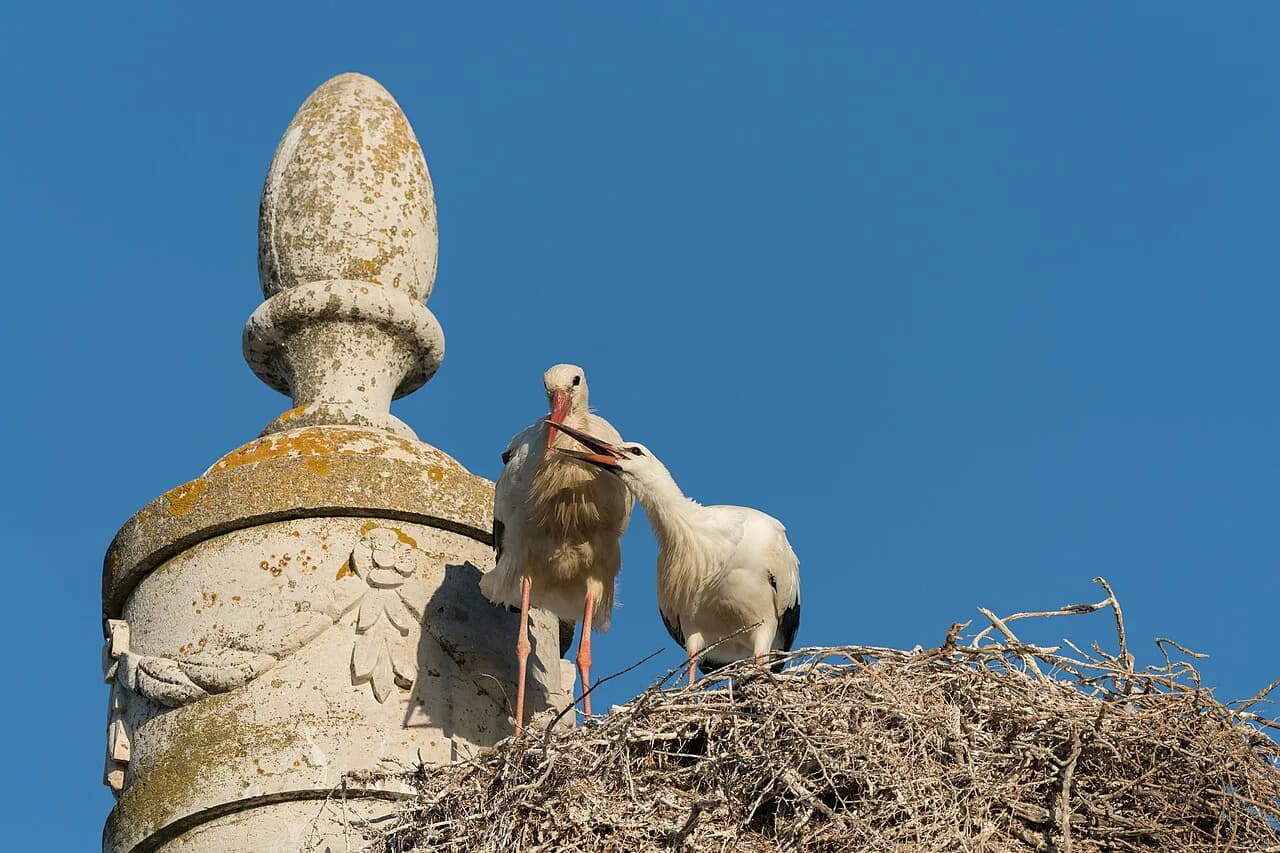
Arco da Vila: Faro's Old Town Gateway

Arco da Vila is the gateway you walk through to get from Faro's marina front into the old walled town, and it is worth more than the thirty seconds most visitors give it. Read the neoclassical facade, look for the interpretive centre inside the arch, then carry on uphill through the narrow streets. This guide covers where the arch stands, what the stonework shows, what sits behind it and how the stop fits into a half-day.
What Arco da Vila is and why it marks the way into Faro's old town
The arch is a monumental portal built at one of the entrances to Faro's walled enclosure, and it is classified as a National Monument. It was commissioned by D. Francisco Gomes de Avelar, Bishop of the Algarve, and designed by the Genoese architect Francisco Xavier Fabri, to mark the sacred character of the Vila-Adentro and dignify the old Praça da Rainha, now the Jardim Manuel Bivar. It was inaugurated in 1812 and is one of the Algarve's most representative pieces of neoclassical architecture.
That history explains why the arch reads as a piece of town planning rather than a standalone monument: it was meant to frame the approach from the lower town into the old one. In practice it still does that job, funnelling pedestrians off the waterfront into the lanes of the Vila-Adentro. Come at it from the garden side and you see the facade as a threshold rather than something to photograph from underneath.

Where it stands: Rua do Município, between the garden and the walled town
Arco da Vila sits on Rua do Município at the edge of Faro's historic centre, and the council gives the address as Rua do Município, 8000-398 Faro, with coordinates of 37°0'52.96"N, 7°56'5.48"W. If you are navigating by phone, the street name is the most reliable search term.
On foot, the natural approach is from the Jardim Manuel Bivar on the marina side, the garden the arch was designed to dignify. Walk across it towards the old town and you arrive at the portal without needing a map. From there the street rises gently towards the cathedral quarter, so the arch marks where flat waterfront gives way to the Vila-Adentro's slopes.

The arch itself: a bishop's commission and a Genoese architect
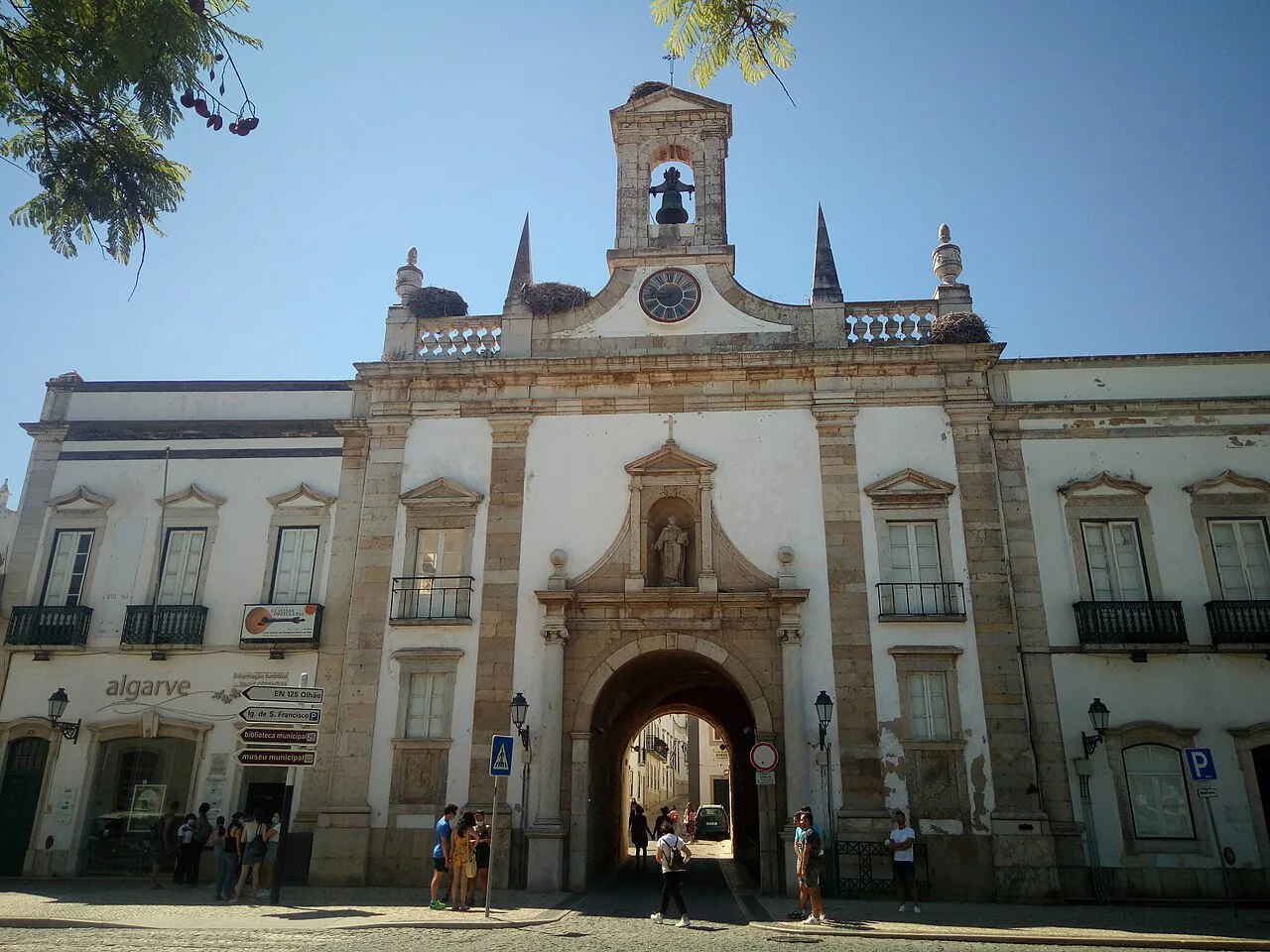
The structure dates from the 19th and 20th centuries, the product of the bishop's commission and Fabri's design, and it was inaugurated in 1812. It is a semicircular arch flanked by Ionic columns carrying an architrave, with a niche topped by a triangular pediment. The composition is deliberately classical and ceremonial, which is why it looks more like stage scenery than a defensive gate.
Look up before you pass through. The niche holds an image of St Thomas Aquinas, the detail most people miss because they are watching their footing on the calçada. Reading the facade from the garden side, then again from inside the old town, takes a few minutes but shows how the arch works in both directions.
Reading the facade: columns, pediment and St Thomas Aquinas
Stand back towards the garden to take in the whole composition, because close up the pediment and niche fall out of view. The facade is best understood as three stacked elements: the columns at eye level, the architrave above them, and the pediment crowning the niche. Between the columns you get the deep shadow of the arch itself, which is what makes the entrance feel like a threshold rather than a wall.
This is a neoclassical front rather than ornament alone, and the interest lies in its proportions rather than in applied decoration. If you are travelling with children or in a hurry, the facade read takes two or three minutes; the payoff is knowing what you are looking at as you walk through.
Inside the arch: the Centro Interpretativo do Arco da Vila
Since 1 December 2015 the interior of the arch has housed the Centro Interpretativo do Arco da Vila, a cultural space that sets out the history of Faro from its origins through its rebirth after the 1755 earthquake to the present day. That makes it a compact primer on the city rather than a single-room exhibit about a gateway, and a logical first stop if you want context before walking the old town.
The exterior can be seen at any hour from the street. The interpretive centre inside is a small cultural space, so check current opening and admission with the municipal museum service before planning around it; if it is closed, the facade and the walk uphill still justify the stop.
The Porta Árabe next door
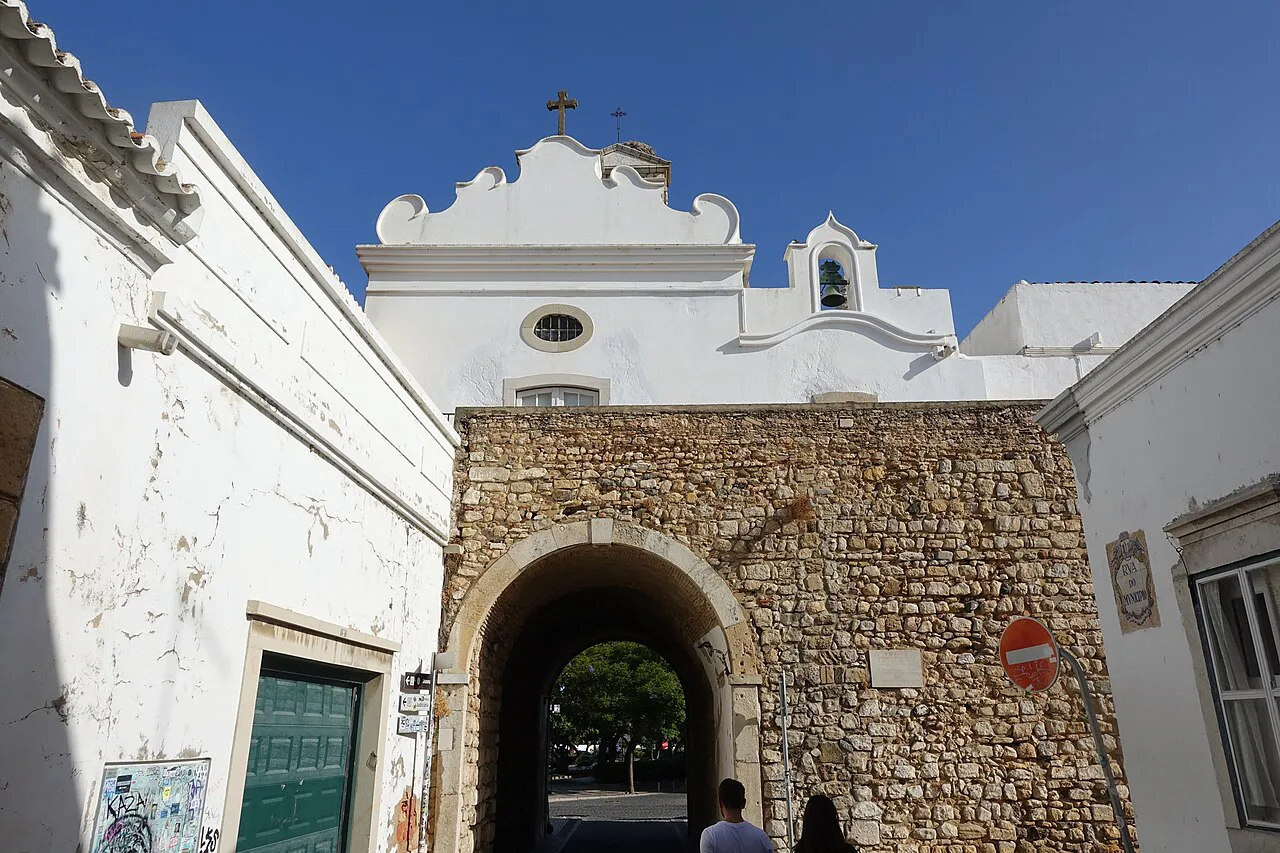
The Porta Árabe stands immediately beside Arco da Vila, and the council lists the two together among the historic centre's points of interest. Most visitors walk past it because the neoclassical arch dominates the view. Slow down at the corner and you will see the older entrance sharing the same stretch of wall.
The Porta Árabe beside the arch marks the older, Islamic-era opening in the same stretch of wall, and knowing that the classical front and the older gate stand side by side explains why the entrance reads as a crossing point rather than display architecture.
How long to allow and how it fits a short Faro walk
Allow 30 to 45 minutes at the arch including the interpretive centre, then walk uphill through the Vila-Adentro to Largo da Sé and the Sé de Faro. The lanes are narrow, paved and gently climbing, so the stretch takes only a few minutes on foot but deserves unhurried attention. The cathedral square is the natural end point of the climb, as set out in these Faro Attractions: 4 Visitor Guides.
This is a natural half-day loop rather than a full day: arch, interpretive centre, cathedral quarter, then back down to the waterfront. If you only have an afternoon, do the arch first because it explains the city you are about to walk through, and save the longer sights for a second visit.
What to pair it with nearby: the garden, the marina and the Capela dos Ossos
The Jardim Manuel Bivar on the marina side is the obvious companion stop, since the arch was built to dignify that square. It is a place to sit before or after the climb rather than a sight in itself, and from the garden you get the best straight-on view of the facade.
The Jardim Manuel Bivar on the marina side is the obvious companion stop, since the arch was built to dignify that square. It is a place to sit before or after the climb rather than a sight in itself, and from the garden you get the best straight-on view of the facade. The Capela dos Ossos, Faro is a second, very different interior to pair with it nearby, while the Palácio de Estoi, beyond the city, deserves its own half-day rather than an add-on to this walk.
Practical points: contact and checking opening times
The council lists the arch at Rua do Município, 8000-398 Faro, with the telephone number 289 802 326 and the email Museu.municipal@cm-faro.pt for the municipal museum service. Use those details to confirm access to the interpretive centre on a specific day.
The council lists the interpretive centre as a cultural space but the municipal page gives no published opening hours or admission price, so confirm current access with the museum service if the interior matters to your visit. The exterior stands in the street, so it can be seen at any hour without a ticket.
Should the arch be your first stop in Faro?
Yes, if you want the old town to make sense: the arch is the doorway into the Vila-Adentro and the interpretive centre gives you the city's story before you walk it. Read the facade, note the Porta Árabe beside it, then climb to Largo da Sé. That sequence turns a photo stop into a proper introduction to Faro.
Frequently Asked Questions
Is Arco da Vila free to see?
The arch itself stands in the street and can be viewed from outside without a ticket. The Centro Interpretativo inside the arch is a separate cultural space, and its admission arrangements should be confirmed with the municipal museum service before you go.
How long does it take to visit Arco da Vila?
Allow around 30 to 45 minutes if you go into the interpretive centre and read the displays, or about ten minutes to look at the facade and pass through into the old town. It works best as the opening stop of a walk uphill to Largo da Sé rather than a destination on its own.
What is the Porta Árabe next to Arco da Vila?
The Porta Árabe is the older entrance standing immediately beside the neoclassical arch, and the two are listed together among Faro's historic points of interest. The arch's classical front and the older gate beside it together give the entrance its layered character.