
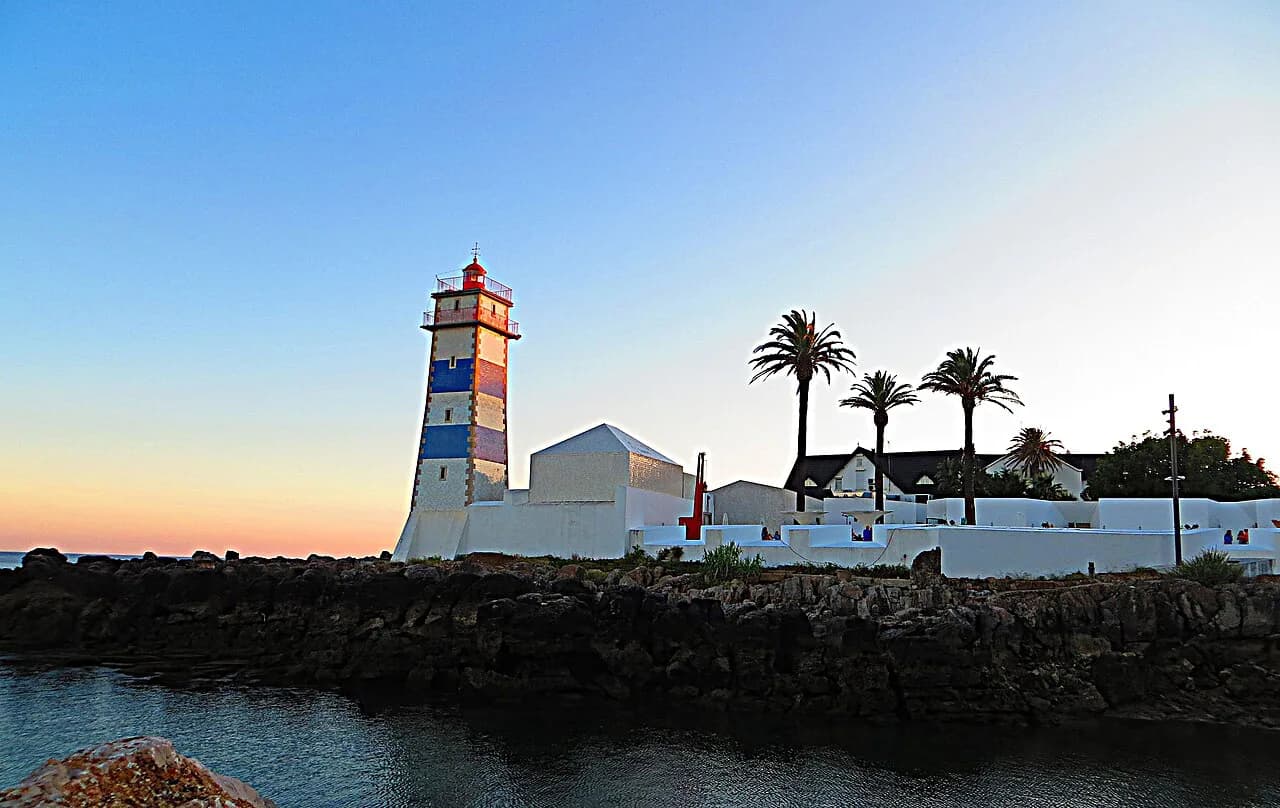
Farol de Santa Marta: the Cascais Lighthouse and Its Museum

Farol de Santa Marta is a short stop in Cascais: a 20 m masonry lighthouse built at the Fort of Santa Marta, first lit on 1 March 1868 and now associated with a lighthouse museum that opened in 2007. Allow around half an hour for the exterior and the setting, and treat it as one piece of a seafront walk rather than a half-day out. This guide covers what the lighthouse is, where it stands in Cascais, the tower's engineering story and the sights that share its stretch of coast.
What Farol de Santa Marta is
The lighthouse stands at the Fort of Santa Marta, which came under the Portuguese Lighthouse Service on 8 November 1867; a small square tower was built the following year as a daytime mark, and its first fixed red light was lit on 1 March 1868. It is a masonry structure 20 m tall, with its light at 25 m and a range of 18 nautical miles. Because the tower sits within a former military position, the visit is as much about the fort's setting above the water as about the lantern.
This is the Cascais lighthouse, not the Farol de Santa Marta at Laguna in Santa Catarina, Brazil, which dominates English-language search results for the name. If a map or listing shows a square stone tower on a Brazilian cape, you have the wrong Santa Marta; the Portuguese one stands on the Lisbon coast.

Where it stands in Cascais
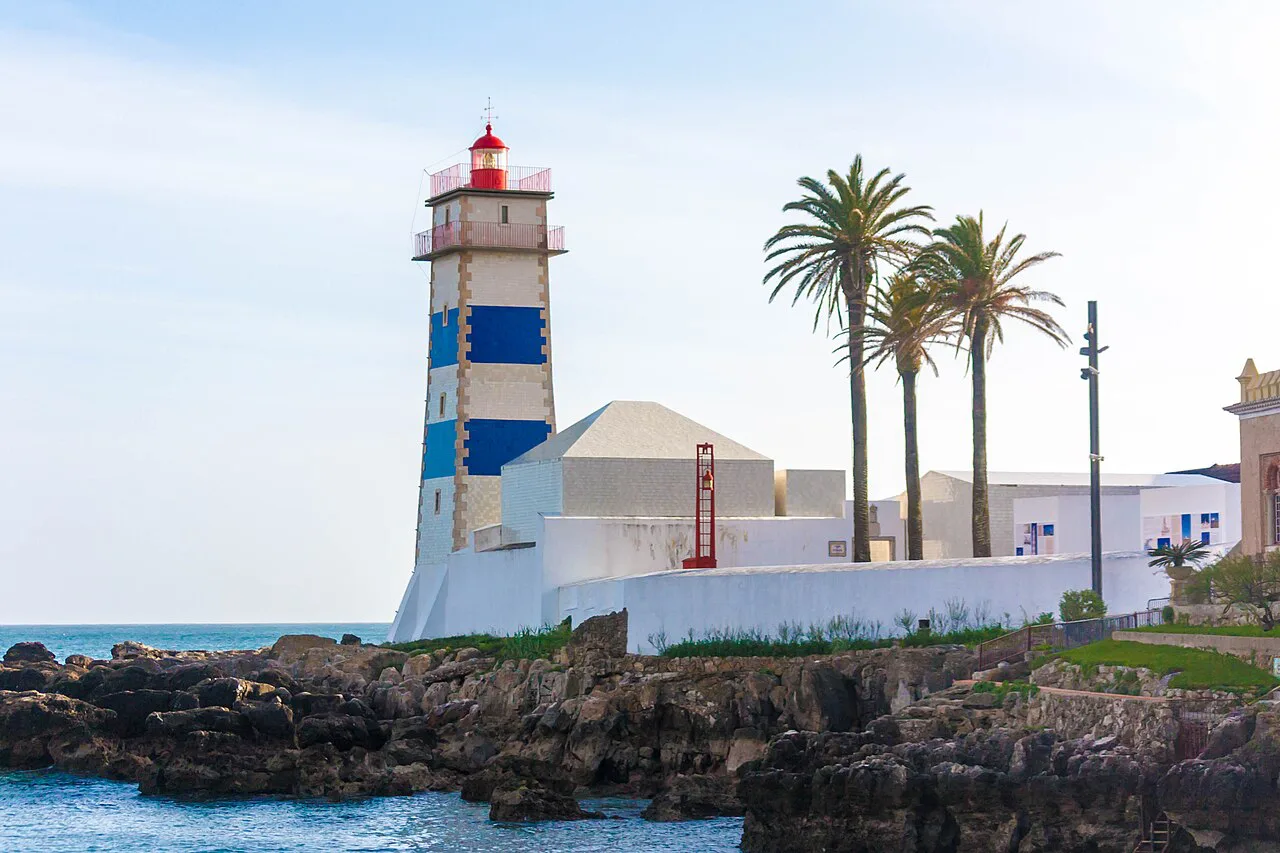
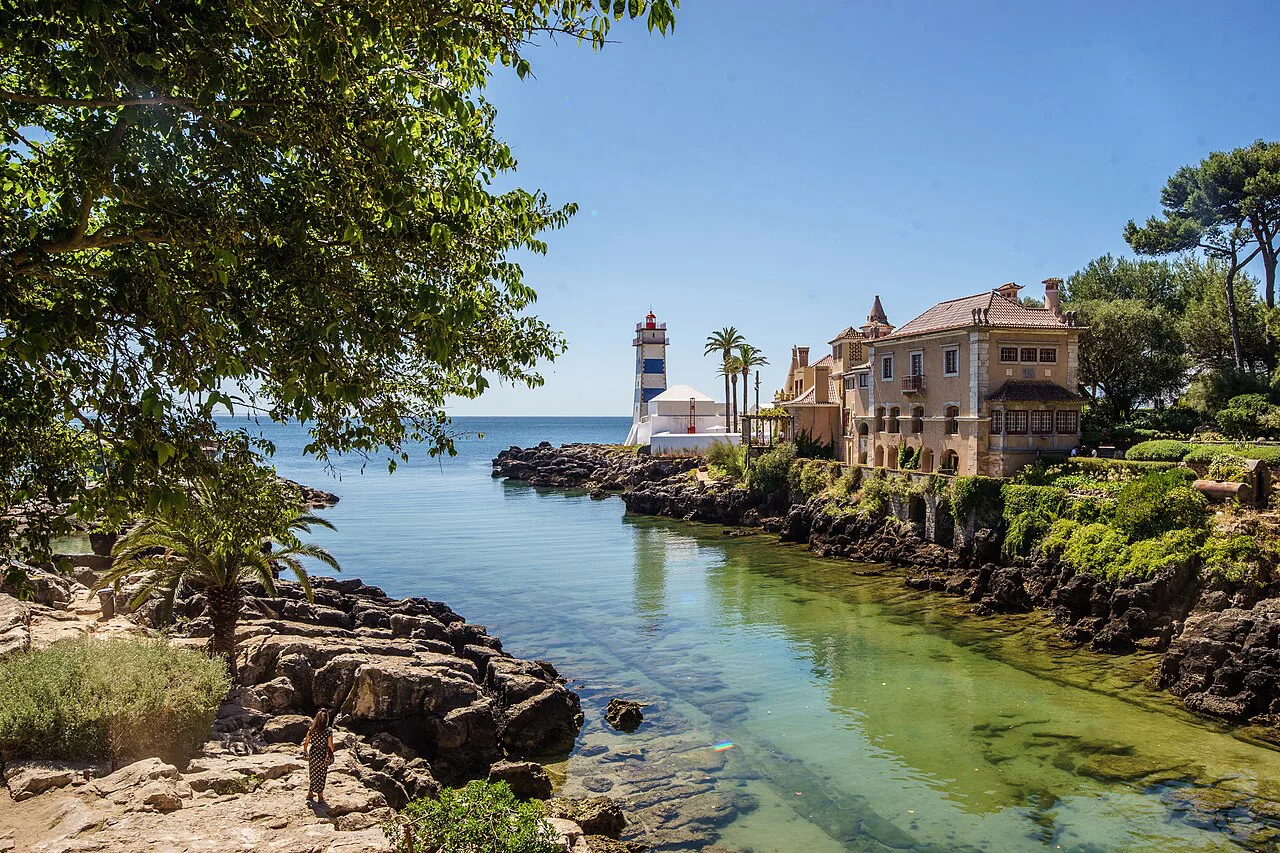
The lighthouse stands at the Fort of Santa Marta on the Cascais waterfront, where the town meets the mouth of the Tagus. From the centre, follow the seafront promenade past the marina and keep going until the fort and tower come into view. It is a flat walk, but allow longer than you expect because of the viewpoints along the way, including the Boca do Inferno.
On foot from the station and the old town, the walk is short enough to combine with the rest of the centre; use the seafront rather than the inland roads, which climb and cut you off from the water. The tower is a landmark you can see from the promenade before you reach it, so navigation is simple.

The tower's story in brief
A lighthouse inspection in 1864 recommended placing a light on the Santa Marta site, and the tower's first fixed red light was lit on 1 March 1868. An 1897 nautical guide described the tower as white with a blue band, marking the northern channel alignment. That detail is worth remembering when you look at the present colour scheme, which follows a long tradition of painted coastal marks rather than decoration.
In 1908 the light was replaced by a fifth-order catadioptric apparatus, which the route describes as still in use, so the optics inside the lantern are original equipment rather than a modern replacement. The tower was raised by 8 m in 1936 to improve visibility, electrified in 1953 and automated in 1981, after which it was de-staffed and remotely controlled. These changes explain why the silhouette reads taller and leaner than a small 1860s harbour light.
The Santa Marta Lighthouse Museum
The Santa Marta Lighthouse Museum opened to the public in 2007, and it is the part of the site with an indoor visit. The tower itself is an active aid to navigation, so museum opening and tower access are separate questions. Plan on the museum as the indoor element, with the fort terrace and tower exterior as the outdoor one. For the practical details, see the things to do in Cascais.
Check the museum's own page for current opening days, ticket prices and any maintenance closure before you set out, and confirm on the day whether the tower itself can be visited.
How long to allow
Budget around 30 minutes for the exterior, the fort setting and a quick look at the museum, and up to an hour if lighthouse engineering and maritime history hold your attention. The lighthouse is not a half-day destination in its own right. Its value comes from being one anchor of a Cascais seafront walk that also takes in the marina and the old town.
A sensible half-day pairs the lighthouse with the green space and small museums inland: the Parque Marechal Carmona, the Museu dos Condes de Castro Guimarães inside it, and the Museu do Mar Rei D. Carlos nearby. Those give you an indoor option if the Atlantic wind picks up on the point.
Nearby lighthouses along this coast
The lighthouse route lists the lights closest to Santa Marta as straight-line distances, not walking routes: Farol da Guia 2 km, Farol do Cabo Raso 6 km, Farol de S. Julião 8 km and Farol do Cabo da Roca 11 km. Those figures are as the crow flies, so do not treat them as a walking itinerary along the coast.
The closest coastal sight on foot is the Boca do Inferno, the collapsed sea arch on the coast north of the lighthouse, a short walk along the shore. Beyond that, the Cascais coast road runs towards Cabo Raso and Cabo da Roca if you have a car or a bus.
If you want more than lighthouses, the Casa das Histórias Paula Rego and the Centro cultural de Cascais give you two contemporary art stops within the town, and the Avenida da República leads back towards the centre and the station from the seafront. Both are an easy add-on to a lighthouse walk rather than a separate trip.
Is the lighthouse worth the walk?
Yes, as a 30-minute stop on a Cascais seafront walk rather than a destination in itself. The draw is the combination of the old fort setting, the 20 m tower with its 1908 optics and 1936 raising, and the museum that opened in 2007. Go for the position and the engineering story, not for a long interior visit.
Check the museum's own page for opening days and ticket prices before you walk out, then build the rest of the morning around the Parque Marechal Carmona and the seafront. For the wider set of Cascais sights and how they fit together, the Cascais Attractions: 7 Visitor Guides hub is the place to start.
Frequently Asked Questions
Is the Farol de Santa Marta the same as the Santa Marta lighthouse in Brazil?
No. The Farol de Santa Marta in this guide is the Cascais lighthouse on Portugal's Lisbon coast. The Farol de Santa Marta at Laguna in Santa Catarina, Brazil, is a separate square stone tower on the Brazilian cape, and English search results often show that one first.
Can you go inside the lighthouse?
The Santa Marta Lighthouse Museum opened in 2007 and is the indoor visit at the site. The tower is an active aid to navigation, and access to it on any given day is a matter for the museum to confirm; check its own page before travelling.
How tall is the Farol de Santa Marta?
The tower is 20 m tall, with the light at 25 m above sea level and a range of 18 nautical miles. It was raised by 8 m in 1936 to improve visibility, which is why it reads taller than a small harbour light.