
Capela dos Ossos: the Chapel of Bones in Évora
The Capela dos Ossos — the Chapel of Bones — is worth half an hour of your Évora day if you accept it for what it is: a small, crowded side chapel of the Igreja de São Francisco whose walls are worked into patterns of skulls and long bones. It is not a museum, there are no displays to read, and the experience is atmospheric rather than educational. This guide covers where it sits in the old town, the walk from the main square, the story behind it, what is actually inside, and how to plan the rest of the morning around it.
What the Capela dos Ossos is and where it sits
The chapel is a small interior chapel attached to the Igreja de São Francisco (the Church of St Francis) in Évora's historic centre. It sits at the end of the Largo de São Francisco, the small square in front of the church, roughly five to ten minutes on foot from the cathedral and the Roman Temple. Because it is a chapel within a working church complex rather than a standalone monument, you enter through the church buildings, which is why the visit feels more intimate than a conventional sight.

How to get there from Praça do Giraldo
Start at Praça do Giraldo, the arcaded square at the heart of the old town where the main cafés cluster. From the square, walk east along Rua 5 de Outubro towards the cathedral, then continue past the Sé and through the streets towards Largo de São Francisco; the whole walk is around 10 to 15 minutes at a normal pace, mostly on cobbles and with some slope. Wear shoes with grip, because Évora's calçada is polished and slippery after rain, and allow extra time if you are stopping at the cathedral en route.
Trains from Lisbon arrive at Évora's station on the edge of town, roughly a 15- to 20-minute walk or a short taxi ride from the old town, and the intercity services from Sete Rios, Entrecampos and Oriente take under an hour and a half. If you are coming for the day, head straight for the chapel before the coach groups build up around mid-morning, then work back through the old town.

The story: 16th-century monks and the message above the door
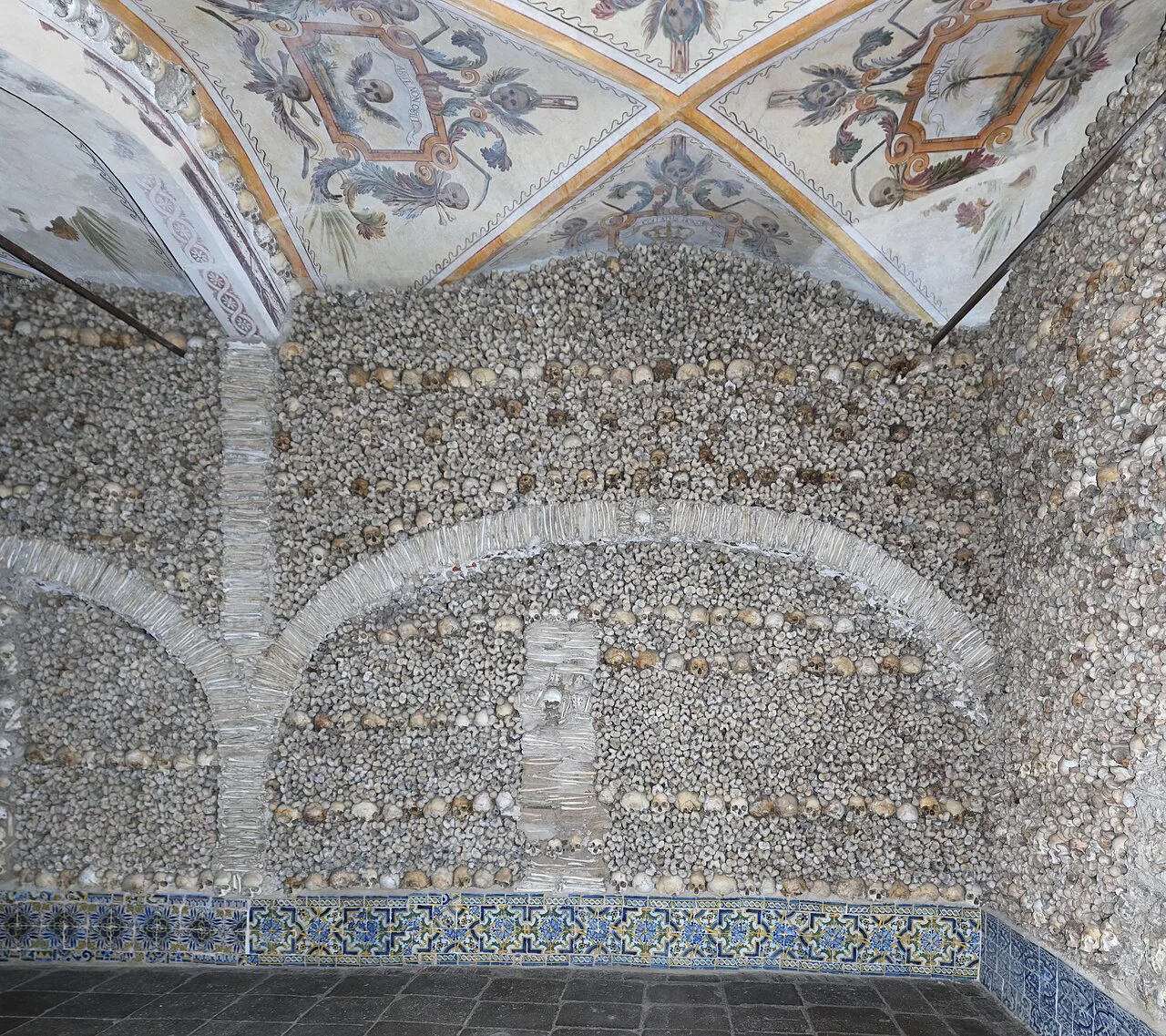
The chapel was built in the sixteenth century by monks, who moved the remains of around 5,000 people into a purpose-built space beside the church. The point was not horror but reflection: the bones of rich and poor alike were arranged into decorative patterns to make the same argument, that status and possessions end in the same place. The inscription over the entrance makes the message explicit: Nós Ossos que aqui estamos, pelos vossos esperamos — we bones that are here wait for yours.
That inscription is the reason to linger at the threshold for a moment rather than pushing straight in. Read it in Portuguese first, then the English gloss; the chapel's effect comes from the bluntness of the welcome, not from any label or curation.
What you actually see inside
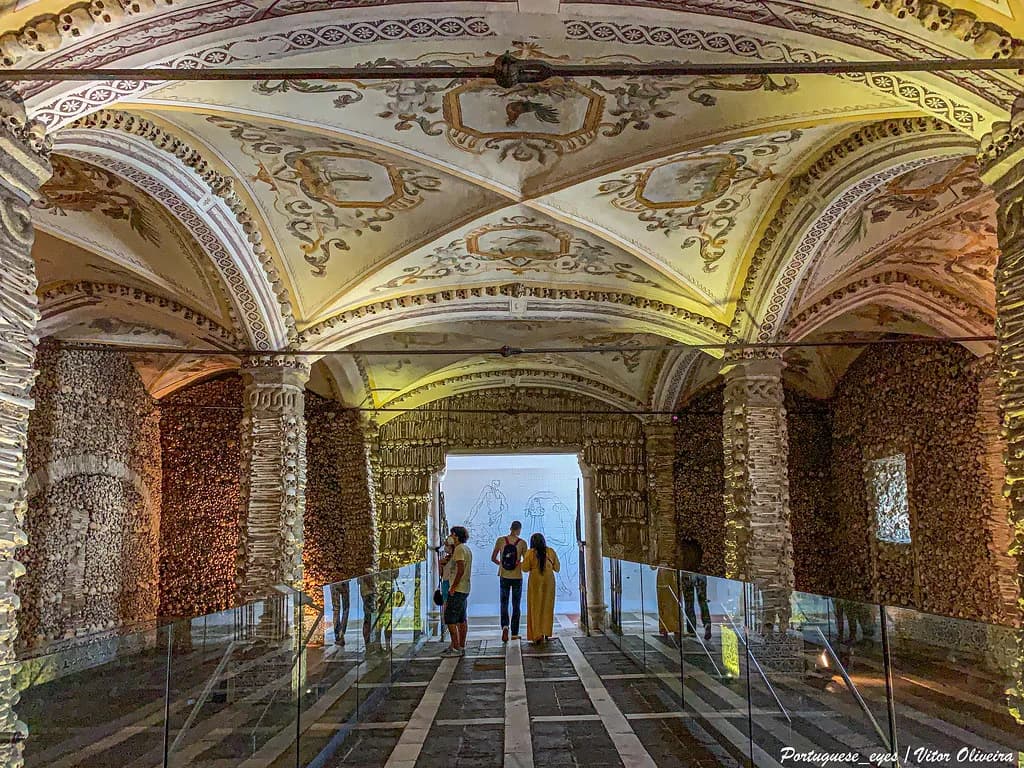
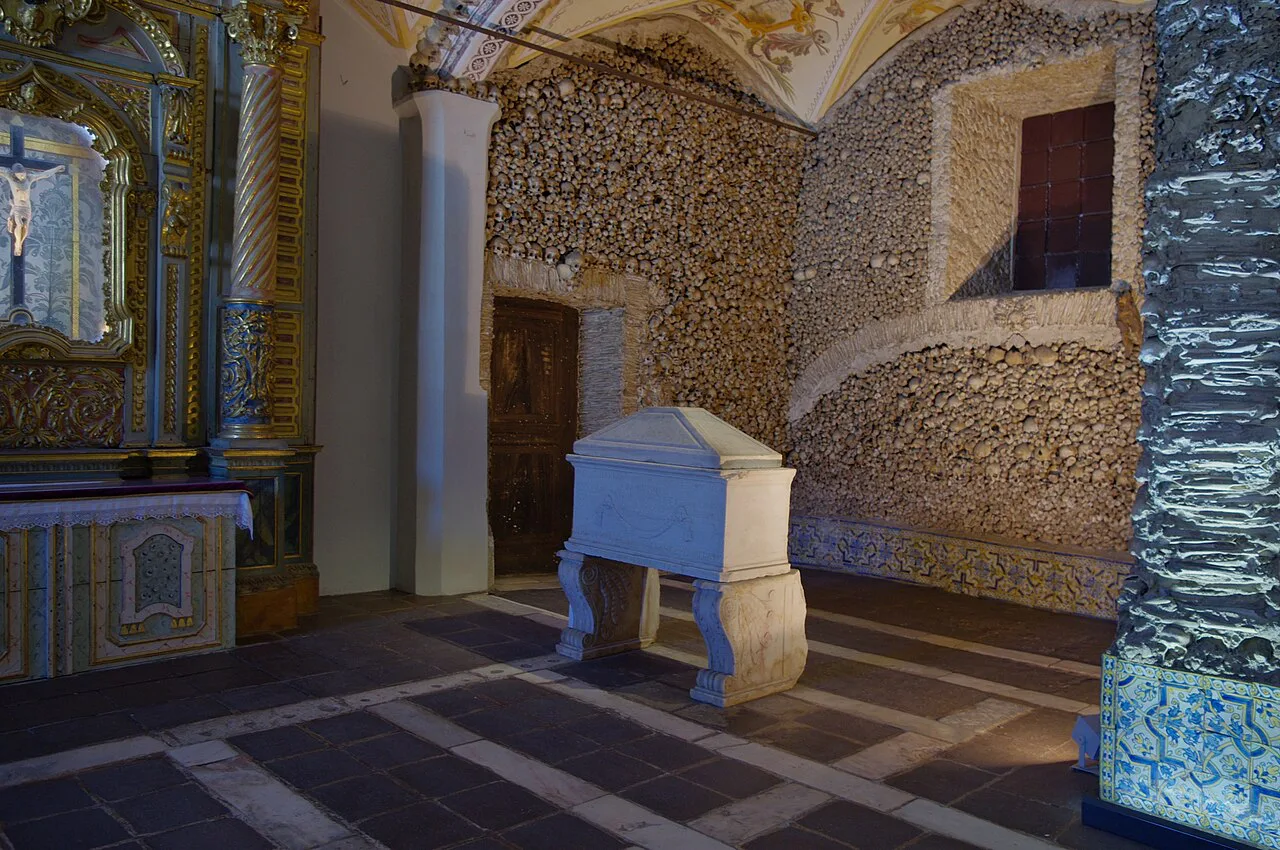
Inside, the chapel runs to three naves, measuring roughly 18.7 metres long by 11 metres wide, with the bones and skulls carefully arranged and held in place across the walls and pillars. Skulls are set in rows and arches, long bones frame the openings, and the ceiling is painted, so the impression is decorative as much as macabre. The chapel is deliberately dim, which slows your eyes down and makes the detail take a minute or two to resolve.
Do not expect captions, interactive exhibits or a route with numbered stops. It is a few rooms, a short circuit and a bench or two, and the honest judgement is that the visit rewards the entrance fee if you engage with the message; anyone hoping for a full museum will be out in ten minutes. The light is low, so steady your camera against a pillar and keep the space clear for other visitors.
How long to allow and how to pace the visit
Budget 20 to 30 minutes inside, plus 10 minutes queuing at busy times and another 20 for the adjoining church and cloister if your ticket covers them. The chapel itself is small, so a large group arriving at the same moment fills it and makes it hard to read the walls; going early or in the early afternoon usually gives you more room. Add a further 15 minutes for the square outside and the walk on to the cathedral.
Pair it with the cathedral and the Roman Temple in one loop: from the chapel, walk back up past the Sé and the temple in around 15 minutes, which makes a natural half-day in the old town. If you would rather see the whole city's sights in one view, climb the cathedral roof before descending to the chapel; doing the roof first means you walk downhill afterwards.
Tickets and opening times
Entry is paid rather than free, and the ticket covers the Capela dos Ossos, as it sits within the Igreja de São Francisco complex; expect a modest few-euro charge rather than a museum-scale ticket. Prices, what the ticket includes and opening hours change with the season and with church services, so check the notice at the door before you build the day around it. Guided city tours of Évora also visit the chapel, with site entrance fees not included in the tour price, which is worth knowing if you are comparing options.
Church services can close access without notice, so check the notice at the door. If your short break has only one full day, put the chapel in the morning and keep the afternoon for the temple and the old town, so a closure does not wipe out the whole visit.
Practical points: tone, crowds and photography
This is a place of Christian burial, not a haunted house. Keep voices low, do not touch the bone work, and skip the jokey poses — the staff and other visitors notice, and the chapel's effect depends on a little quiet. Children generally cope better than adults expect, but brief them beforehand so they understand what they are looking at.
Low light is the main practical constraint. A modern phone camera will manage a steady shot at the brighter end of the chapel, but the deep corners stay dark without a tripod, which you will not want to set up in a crowded space. Leave bags in front of you rather than on your back, because the aisles are narrow and turning round in a crowd is easy to get wrong.
Nearby: what to combine with the chapel
The Roman Temple, known locally as the Templo Romano and standing beside the Jardim Diana, is a 10- to 15-minute walk uphill from the chapel. It dates to the 1st century AD and has no museum or informational displays, so a simple walk around is all it takes to see it. The cathedral, with its Gothic cloister and roof climb, sits between the two and is the obvious next stop; admission is €4, or €5 including the treasury. Between them, these three fill a comfortable morning without any transport.
Beyond that, the old town's pleasure is aimless walking: the Largo da Porta de Moura, the quieter lanes towards the aqueduct and the university quarter all sit within a 20-minute walk of São Francisco. If you are planning a second day, the megalithic sites outside town, including the Almendres Cromlech, need a car or a tour and are best treated as a separate outing.
Is the Chapel of Bones worth the entrance fee?
Yes, if you go for the inscription and the atmosphere rather than a museum experience: half an hour and a few euros buys you one of the most striking interiors in the Alentejo. Skip it if dark, cramped spaces and human remains unsettle you, and spend the time on the cathedral roof instead. Either way, build the chapel into a morning that includes the Roman Temple and the cathedral, and the detour costs you almost nothing. For more, see Évora guide.
Explore more Évora guides
Frequently Asked Questions
Is the Chapel of Bones in Évora free?
No. Entry is ticketed at the church, and the chapel sits inside the Igreja de São Francisco complex rather than on the street. The charge is modest, but prices and what the ticket includes change, so confirm at the door when you arrive.
How many bodies are in the Chapel of Bones in Évora?
The bones of around 5,000 people were moved into the chapel, which was built for them in the sixteenth century. They are arranged across the walls and pillars, with skulls set in rows and long bones framing the openings.
How long does it take to visit the Capela dos Ossos?
Allow 20 to 30 minutes inside, plus time to queue at busy periods and another 20 minutes for the adjoining church. The chapel is compact, so most visitors are through it faster than they expect and then linger outside on the square.
Can you take photographs inside the Chapel of Bones?
There is no reliable published photography policy for the chapel, so ask at the door. The light is very low, so steady your phone against a pillar and avoid flash out of respect for other visitors; the space is small enough that a crowd forms quickly.