
Praça do Giraldo: Évora's Main Square and Where to Start
Praça do Giraldo is Évora's main square and the best place to begin a short break, because the two streets that leave it lead to the city's two main clusters of monuments. Give the square itself half an hour, then pick your exit, with these Évora Attractions: 8 Visitor Guides as your onward plan.
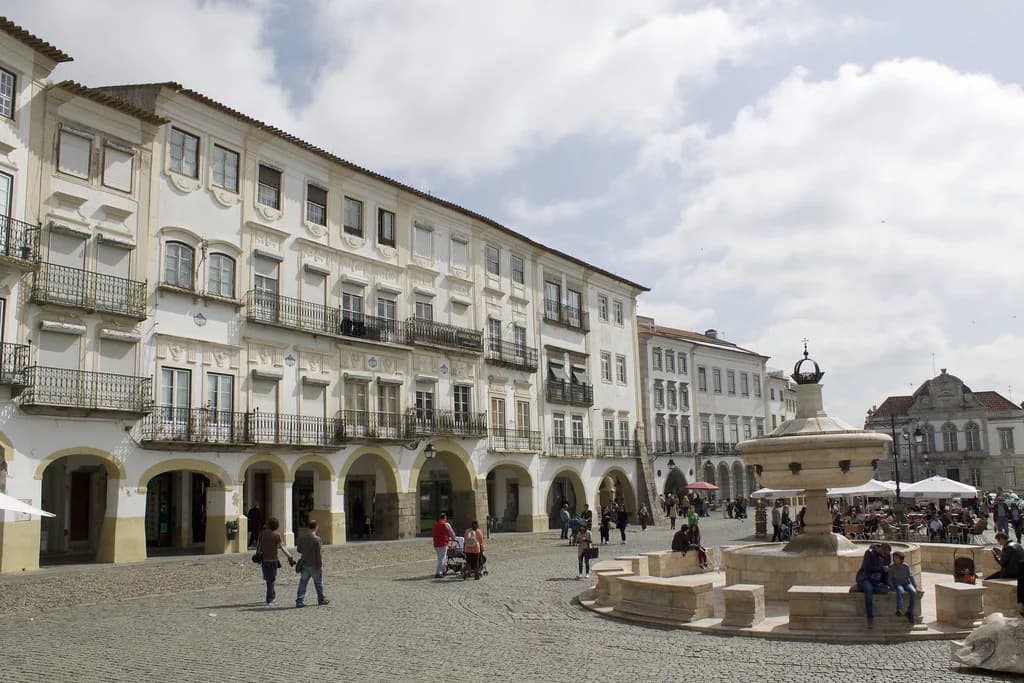
The square is ringed by arcaded buildings with wrought-iron windows, with outdoor cafés set out beneath them. It is flat and cobbled, so it works as a meeting point before you commit to the steeper lanes that climb towards the cathedral.
What Praça do Giraldo is and why it works as a starting point
This is the historic heart of the city, and the square takes its name from Giraldo Sem Pavor, the knight credited with helping Portugal's first king expel the Moors from the region in 1165. Its older name was Praça Grande, and the site has served as an execution ground during the Inquisition, the scene of the Duke of Bragança's beheading in 1484, and a bullring between the 15th and 19th centuries.
Treat that past as background rather than the reason to come. The practical case for starting here is orientation: the tourist office sits in the biggest building on the square, cafés give you somewhere to sit with a map, and both of the streets you need begin within a few metres of the fountain.

Where the square sits in Évora and how to reach it on foot
Praça do Giraldo is inside Évora's old centre, and you reach it on foot through the lanes rather than by driving up to the edge of the square. If you arrive by bus or car, leave the vehicle outside the historic centre and walk in; the streets around the square are narrow and cobbled, and the whole point of the layout is that you cover it slowly.
The obvious approach for a first-timer is from the direction of the Porta de Moura, the old gate on the southern side of the walled town, which puts you into the grid of streets that opens onto the square. Once you are standing at the fountain, everything else in the centre is a short walk away.

The marble fountain and the arcaded buildings around the square
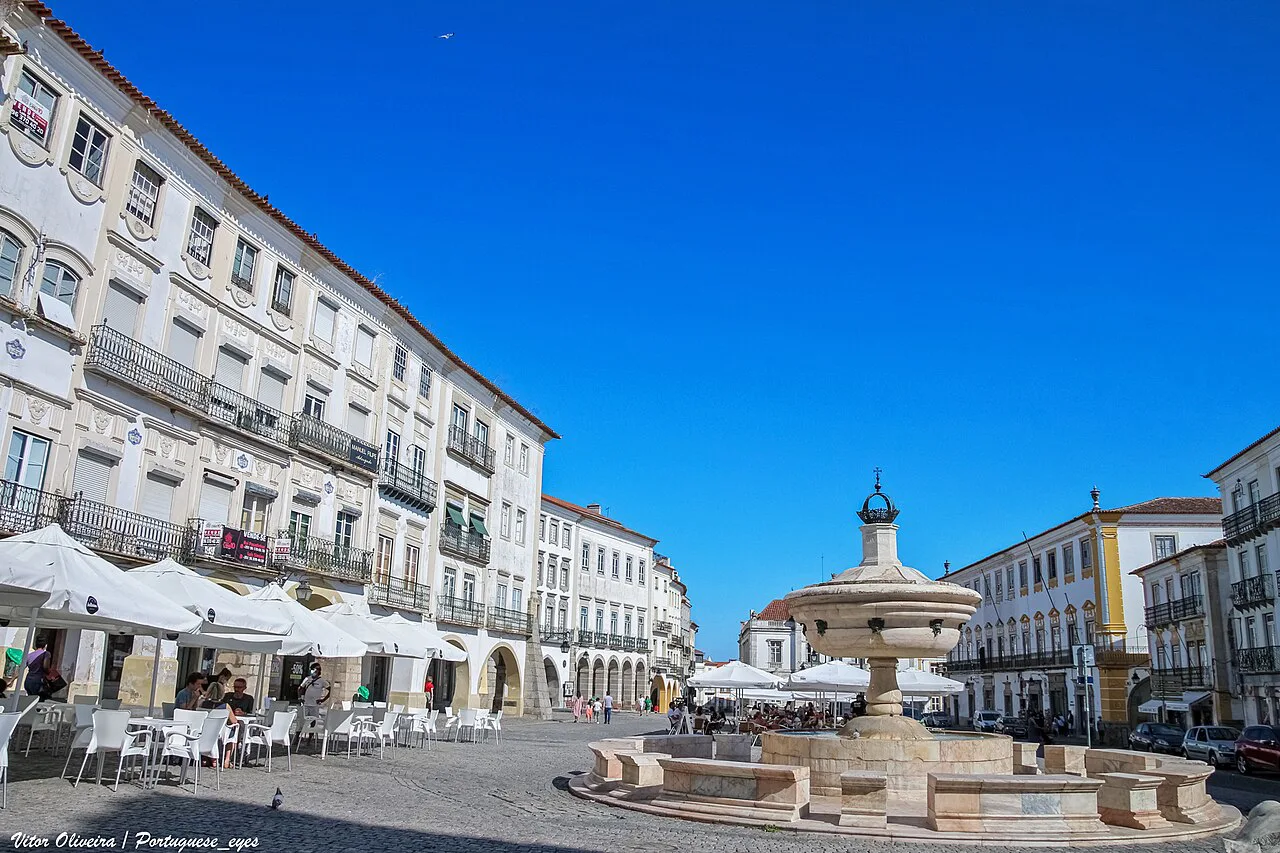
The Renaissance marble fountain in the middle of the square dates from 1571, and it is the landmark to navigate by when you come back to the square from different directions. Face it and you can work out which corner leads where without a map.
Look up at the arcades rather than straight ahead. The covered walkways, the wrought-iron balconies and the uniform height of the façades are what give the square its shape, and the cafés use the shade under the arches as their terrace.
Igreja de Santo Antão: the Renaissance church facing the square
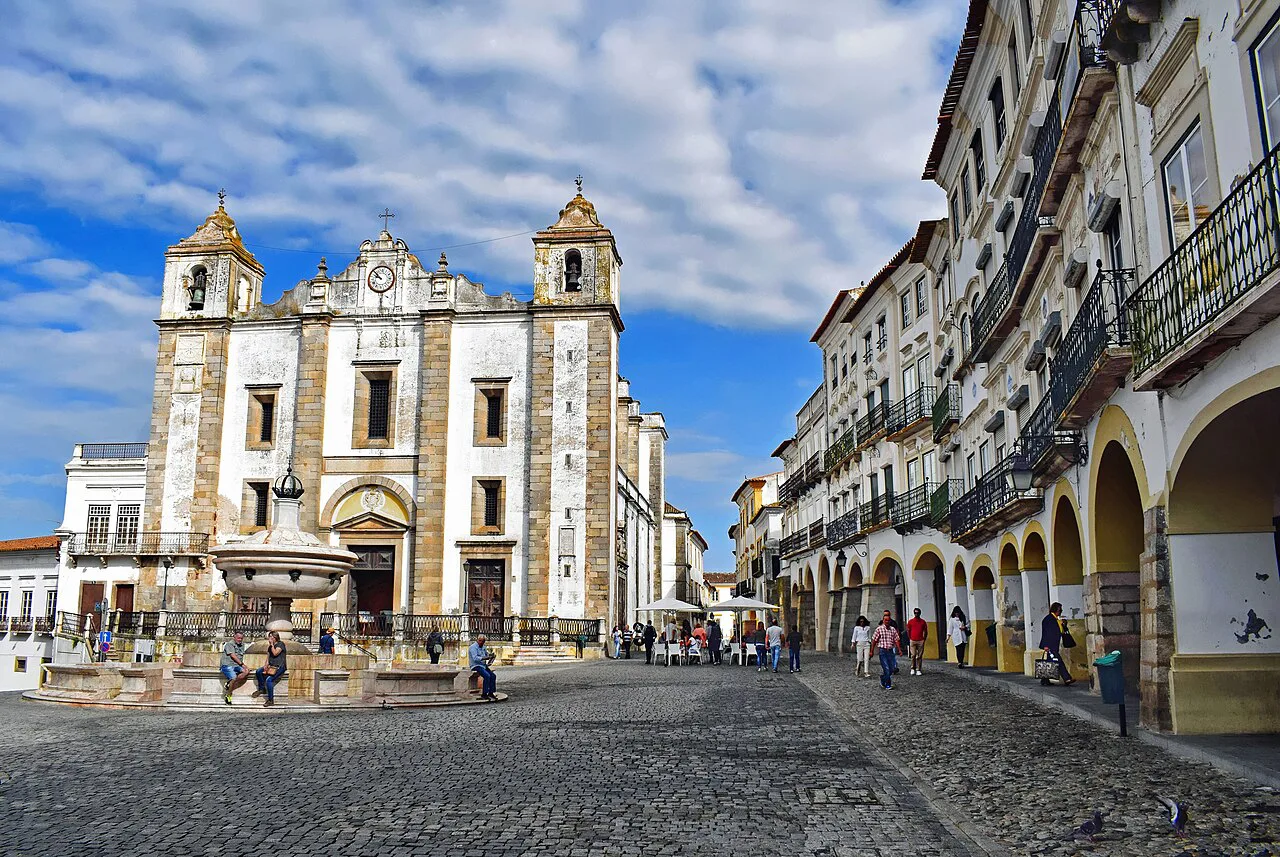
The 16th-century Igreja de Santo Antão faces the square and the fountain, and its baroque and rococo interior is held up by thick columns. Step in if the doors are open; it is a five-minute look that gives you a sense of the Alentejo's church interiors before you pay for the bigger monuments.
The church is also the reference point for the shopping street beside it, Rua João de Deus. A Roman arch once stood outside the church but was destroyed in 1570, which is a reminder that the square has been rebuilt more than once.
The Bank of Portugal building and the square's former town hall
The Bank of Portugal occupies the site of the old town hall, a Manueline building that was demolished to make way for it. The replacement is elegant enough, but it is a swap worth knowing about when you look at the square's architecture: what you see is not the medieval civic centre.
For the older layers of Évora's civic life, look instead at the palaces and walls elsewhere in the centre. The Cadaval Palace, on the cathedral side of the old town, is the name to look out for when you want the aristocratic rather than the banking version of the city.
Café Arcada and a pause for Portuguese pastries under the arcades
Café Arcada, under the arcades, dates from 1942 and was once a grand café with its own orchestra and concerts. It has been modernised and no longer has its historic interior, so come for a coffee and a Portuguese pastry rather than for atmosphere.
That is the honest trade-off: the setting on the square is the draw, the room itself is ordinary. If you want a sit-down lunch instead of a snack, use the cafés as a scouting stop and walk a few streets off the square, where the tascas are.
Rua 5 de Outubro towards the cathedral and Roman Temple of Diana
Take Rua 5 de Outubro from the square if you want the cathedral and the Roman Temple of Diana. It is the higher, more monumental route, climbing into the oldest part of the city where the Sé de Évora and the temple stand close together.
Budget a half-day for this direction, because the climb is slow and the rewards are dense. The temple is the free, open-air highlight, while the cathedral and the neighbouring monuments are the ones that take time and, in most cases, a ticket.
Rua João de Deus, the shopping street leading to the aqueduct
Rua João de Deus runs beside Santo Antão and is Évora's main shopping street, with several international chains alongside the local shops. Follow it and you eventually reach the arches of the aqueduct, which is the other half of the city's story.
Choose between the two exits rather than trying to do both at once. Rua 5 de Outubro is the route for monuments and views, Rua João de Deus for shopping and the aqueduct, and together they make a natural figure-of-eight if you have a full day.
The tourist office in the square and what it is useful for
The tourist office is in the largest building on the square and stocks pamphlets on Évora's attractions plus information on the wider Alentejo. Use it for printed maps and for confirming which monuments are open on the day you are there, rather than for booking your whole trip.
Opening days and ticket prices for the cathedral, the chapel of bones and the other charged interiors change, so settle them at the desk or on the official pages before you set off. The square itself is an open public space you can walk through at any time, which is why it makes a sensible first stop even on a short break.
How much time to allow and when the square is quietest
Give the square half an hour on a first pass: the fountain, the church, a coffee under the arcades and a look at the two street openings. That is enough to decide how to split your day, and you can come back in the evening when the cafés spill out.
Mornings are the calmer time to see the architecture, before the café terraces fill and the tour groups pass through. The square stays lively into the evening, so if you want photographs of the arcades without crowds, go early and come back later for the atmosphere.
What is nearby: Porta de Moura, the cathedral and the Roman Temple
Everything in the old centre is within walking distance of Praça do Giraldo. The Porta de Moura and the city walls are one direction, the Sé and the Roman Temple another, and the Capela dos Ossos is a short walk beyond the cathedral in the direction of the Igreja de São Francisco.
If you have a car and a spare half-day, the megalithic sites in the countryside are the obvious extension: the Almendres Cromlech and the Great Dolmen of Zambujeiro lie outside the city and need their own transport.
Which exit should you take from the square?
Take Rua 5 de Outubro if this is your only day in Évora and you want the cathedral and the Roman Temple; take Rua João de Deus if you would rather shop and end at the aqueduct. With two days, do one each morning and keep the square for coffee and orientation in between.
Whichever way you go, check opening days and ticket prices at the tourist office or on the official pages before you set out, since the charged monuments keep their own calendars.