Azulejos in Funchal: Where to See the Town's Painted Tiles
Find azulejos in Funchal, from the Mercado dos Lavradores entrance panel to the Monte Palace history wall, and learn what the painted Portuguese tiles show.
On this page
You can see azulejos in Funchal in half a day, and two stops carry the story: the tiled entrance panel at the Mercado dos Lavradores (worker's market) and the long history sequence inside Monte Palace Madeira. The first is a single façade piece you pass on the way in; the second is a narrative wall running from the 12th to the 20th century. This guide covers what both show, how to read a panel, and how to link them on foot and by cable car.
Funchal has no dedicated tile museum, so tile-hunting here is a walk rather than a gallery visit. That suits a short break: you fold the tiles into a morning at the market and an afternoon in the hills above the city, with time left for the rest of the things to do in Funchal.
What azulejos are and why they cover so much of Funchal
Azulejos are the glazed ceramic tiles that clad Portuguese buildings, usually in repeating patterns or painted scenes, and the word is the one to use when you ask for them. In Funchal they turn up where you would expect on a Portuguese island city: at entrances, on façades and inside gardens, rather than in one central collection. Thinking of them as street furniture rather than exhibits is the right frame for a short visit.
The practical consequence is that your tile-hunting is free at street level and ticketed only where the tiles sit inside a paid garden. Funchal's steep layout means the pieces are spread between the seafront, the old town and Monte, high above the centre, so plan the stops around transport rather than trying to sweep them all on foot.
Start at the Mercado dos Lavradores: the tiled entrance panel
The Mercado dos Lavradores, the city's main produce market, carries an azulejo panel at its entrance gateway, and it is the easiest tile sighting in Funchal because you reach it on level ground in the old town. Treat it as a warm-up: a single framed composition above the door rather than a sequence, best seen in daylight when the glaze reads properly.
Go inside afterwards. The market is the place to see Funchal's everyday colour, with produce stalls and a fish hall, and it pairs naturally with a morning in the Funchal old town, where the lanes around Rua de Santa Maria reward slow wandering. Allow about an hour for market and entrance panel together.
The market itself is worth a page of its own if you want to plan the visit around stallholders and produce rather than tiles, and it anchors the lower half of any tile walk.
Monte Palace Madeira: a tiled history of Portugal
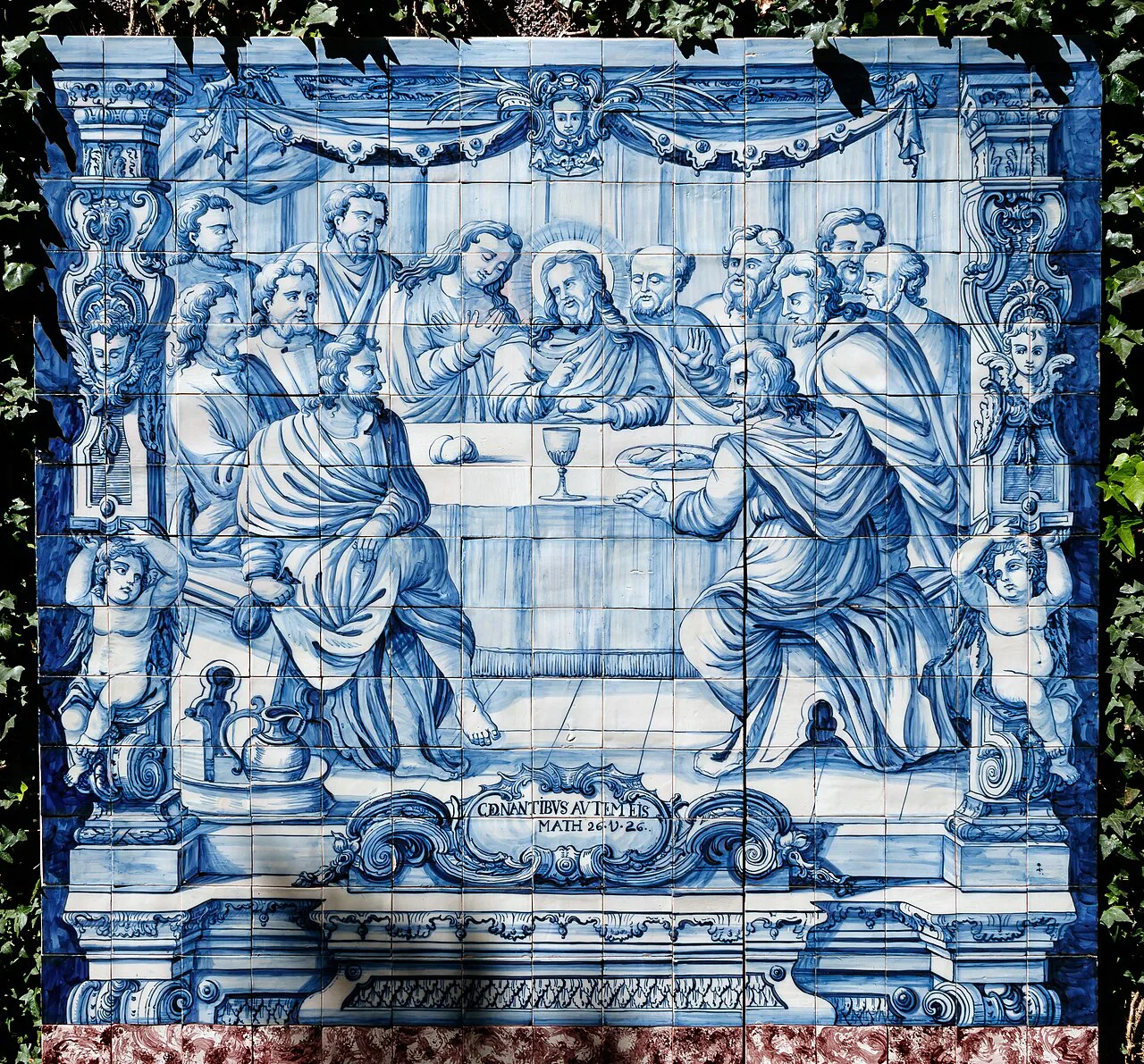
The serious azulejo sighting is up at Monte Palace Madeira, a museum and botanical garden in Monte, where a row of azulejos depicts the history of Portugal from the 12th to the 20th century. This is the piece to give time to: a long narrative wall you read left to right, panel by panel, rather than a decorative border. Admission is reported at €12.50, which also includes a park map and a glass of Madeira wine served in one of the two cafés overlooking the city.
Budget two to three hours for the garden as a whole, because the tiles share the grounds with koi ponds, Japanese and Chinese garden elements, old olive trees and city views. If tiles are your priority, head for the history panels first and let the rest of the garden fill the remaining time.
Getting to Monte: cable car fares and the sledge alternative
The Teleférico cable car runs from the Funchal Marina area up to Monte, arriving right in front of the entrance to Monte Palace Madeira, which makes it the simplest way to pair the market panel with the garden sequence. Reported fares are €18 return or €12.50 one way, so a return ticket only pays if you plan to come back down the same way.
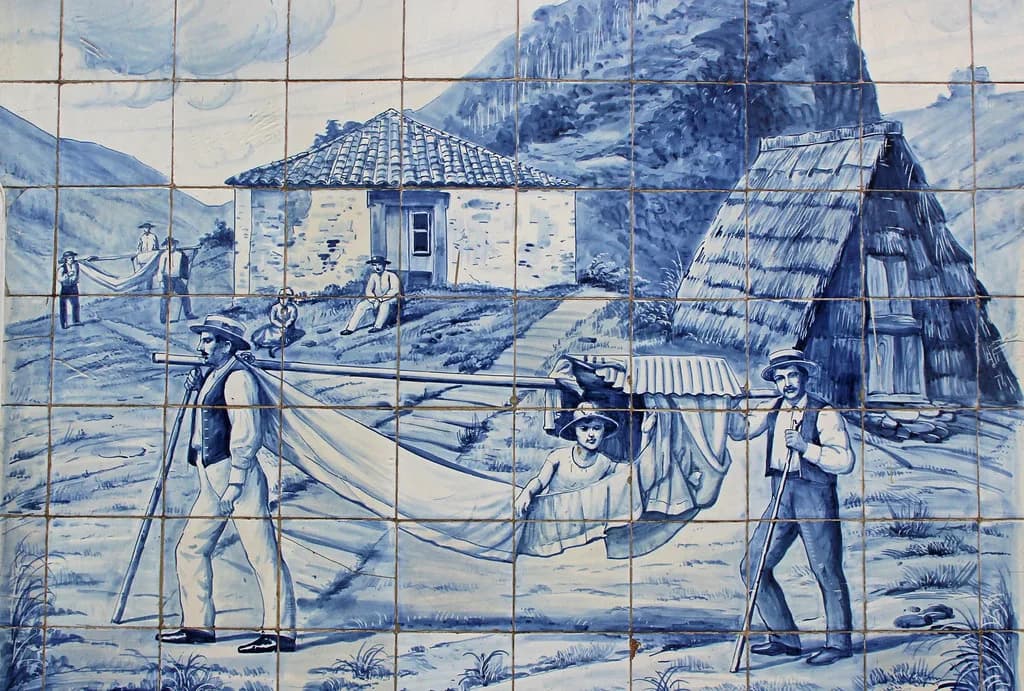
The alternative down is the Carreiros do Monte basket sledge, a wicker toboggan run by drivers in straw hats, reported at around €30 for a ten-minute ride. It is a spectacle with a price to match; watching from the garden wall costs nothing, and the ride ends well below Monte, so check where you will rejoin the city before committing.
There is also a second cable car serving the Jardim Botânico Funchal, useful if you want both gardens in one day without a car, though that adds a separate fare and a second chunk of time.
Reading a panel: colour, pattern and the blue-and-white tradition
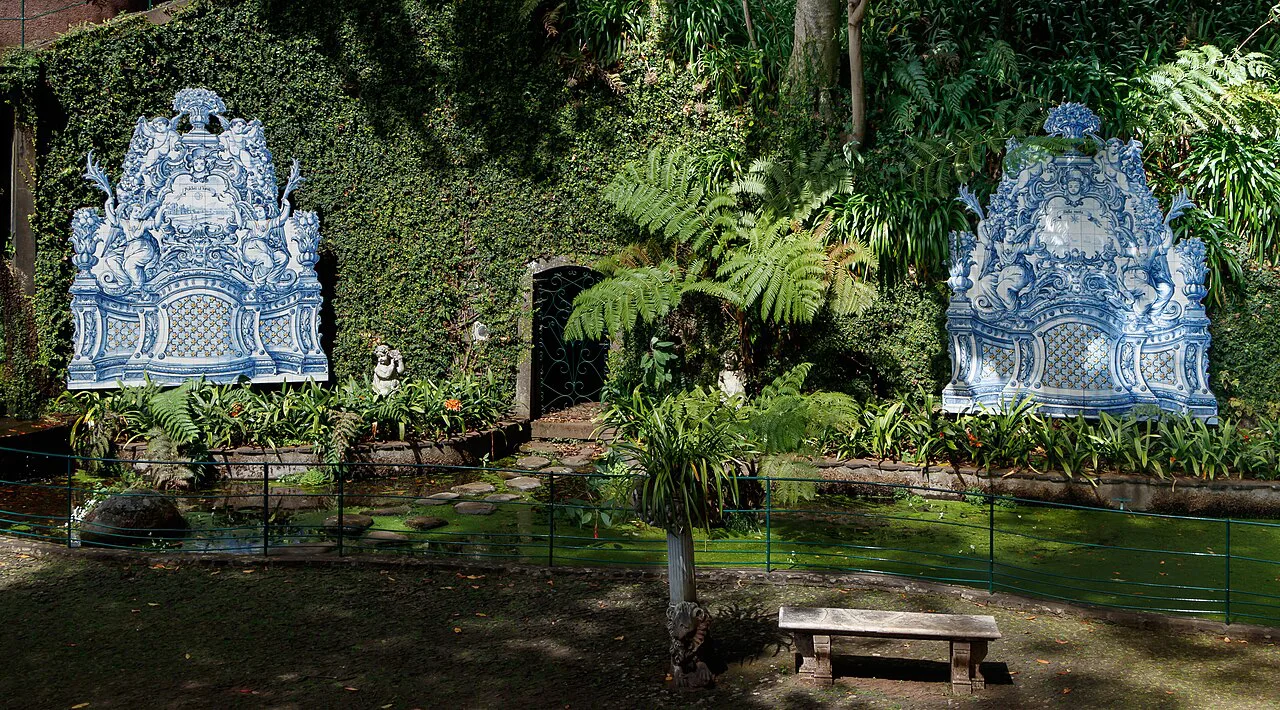
Most travellers recognise azulejos by their blue-and-white look, but the tradition runs from repeated geometric patterns to full painted scenes, and Funchal gives you examples of both registers. Patterned tiles are about rhythm and coverage on a building; pictorial panels are about narrative, which is why the Monte Palace sequence reads as history.
On a pictorial panel, look at the edges as well as the figures. Borders, corner motifs and the way tiles are cut at the frame tell you how the composition was designed for its wall, and they are the details a quick glance misses. Because Funchal's street tiles are often high up or behind glass, daylight and a few steps back matter more than a close-up.
A half-day route between the tiles and the market
Start at the Mercado dos Lavradores entrance panel in the morning, then walk through the old town lanes and down towards the seafront, where the cable car station sits near the Marina do Funchal. Ride up to Monte, spend your time at the history panels and the viewpoints, then return by cable car or take the sledge down.
If you prefer company and commentary on the lower half, a guided Funchal walking tour can cover the old-town streets before you break off for Monte. Keep the two halves separate so you are not rushing the garden.
Blue-and-white versus polychrome: what the difference tells you
Blue-and-white panels dominate the mental image of Portuguese tiles, but polychrome work, using yellows, greens and other colours, is equally traditional on façades and in gardens. In practice the distinction tells you less about age than about taste and fashion — a bold multicolour scheme is a statement where blue-and-white reads as restrained.
For a visitor, use the difference as a way of looking rather than a dating tool. Note which panels repeat a pattern and which tell a story, and which sit on a public wall versus inside a paid attraction, because that division explains why some tiles are weathered and others are protected.
Where tile-hunting fits into a one to three day Funchal break
On a one-day visit, pair the market entrance panel with Monte Palace and skip everything else tile-related, since the cable car and the garden eat most of a half-day. With two or three days, put the tiles on a morning and use the afternoon for the wider Funchal Attractions beyond the centre, so the tile walk does not crowd out the rest of the city.
If you are chasing specific buildings rather than general tile-spotting, the churches in Funchal and the museums in Funchal are the other obvious places to look for interior tilework. Build those into a separate half-day so each stop gets proper time.
Is Monte Palace worth it just for the tiles?
Yes, if you treat the visit as a garden with a history wall inside it rather than a tile museum. The admission buys two to three hours of grounds, city views and the 12th-to-20th-century panel sequence, and the cable car makes the trip easy from the seafront.
If your time is tighter, see the market entrance panel and leave Monte for a longer stay; if you have a full day, do both and walk the old town in between. Before you go, confirm current cable car fares and garden admission on the operator's own pages, since these are the numbers that shift.
Explore more Funchal guides
Frequently Asked Questions
Is Funchal in the Azores?
No. Funchal is the capital of Madeira, an Atlantic island archipelago that is a separate Portuguese region from the Azores. The two groups sit in different parts of the Atlantic and are reached on different flight routes, so a Madeira short break does not include the Azores.
Is there a tile museum in Funchal?
Funchal does not have a dedicated azulejo museum. The tiles are seen in situ: the entrance panel at the Mercado dos Lavradores and the history sequence inside Monte Palace Madeira are the two clear examples, with other work on façades around the city.
Why are Portuguese azulejos so often blue?
Blue-and-white is the best-known scheme, but Portuguese tilework also uses yellows, greens and other colours, and both traditions appear on Funchal's walls. Colour choice reflects design fashion and cost rather than a single fixed rule.
How long does a tile-focused walk in Funchal take?
Allow about half a day. The market panel takes minutes, but the cable car up to Monte and two to three hours in the Monte Palace grounds dominate the outing, so plan the rest of the day around that block.
Sources
Notes for your next Portuguese break
Optional updates to our town guides.
You might also like
Continue reading
More guides you'll find useful