
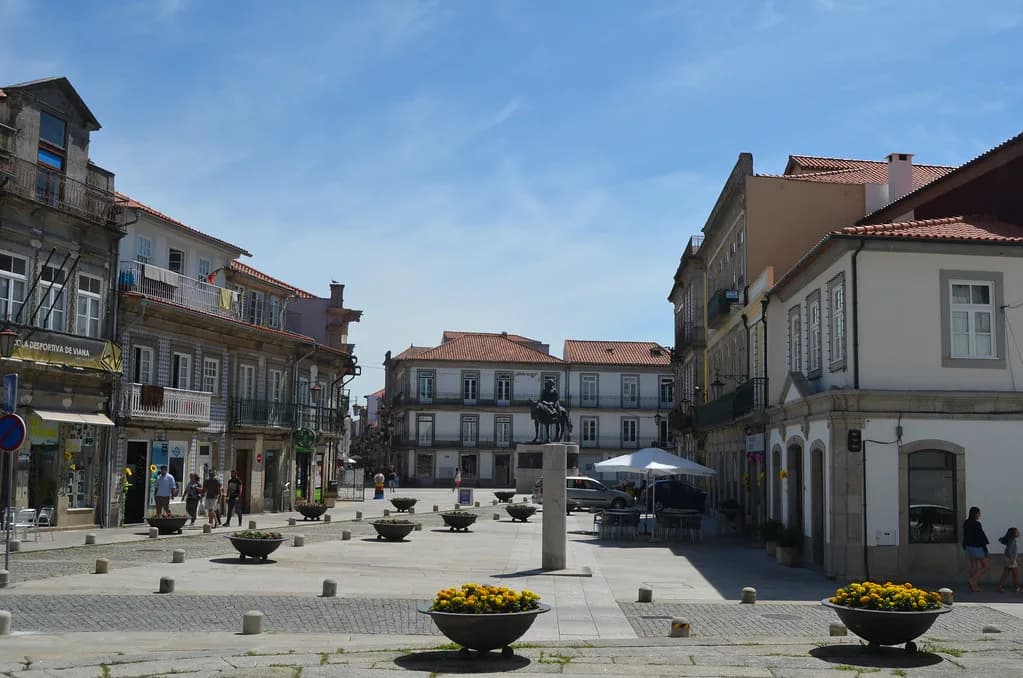
Praça da República, Viana do Castelo: what to see in the old town square
Praça da República deserves ten to fifteen minutes, not a morning: it is a compact old-town square in Viana do Castelo with a stone chafariz at its centre and cafés along its edges. Treat it as a hinge between the Sé, the surrounding lanes and the riverside rather than a standalone sight, and the rest of a short break falls into place around it. This guide covers where the square sits, what you are looking at, how long to allow and what to pair it with.
What Praça da República is and why it is worth ten minutes
This is a paved square in the historic centre, not a museum with a turnstile: you walk in, look around and move on. Its pull is the setting, a fountain at the centre and a ring of old buildings and cafés that show how the old town works as a piece of street life. If you are building an itinerary, the square earns its place because it sits inside the old burgo rather than on its edge.
Be clear about the trade-off. Ten to fifteen minutes covers the fountain and a lap of the façades; longer only if you sit down with a coffee and watch the square fill up. Anyone expecting a monumental plaza on the scale of a big-city Praça will find it modest, and that modesty is the point: it is a working corner of the old town, close to the cathedral and the river.

Where the square sits: inside the old walled burgo
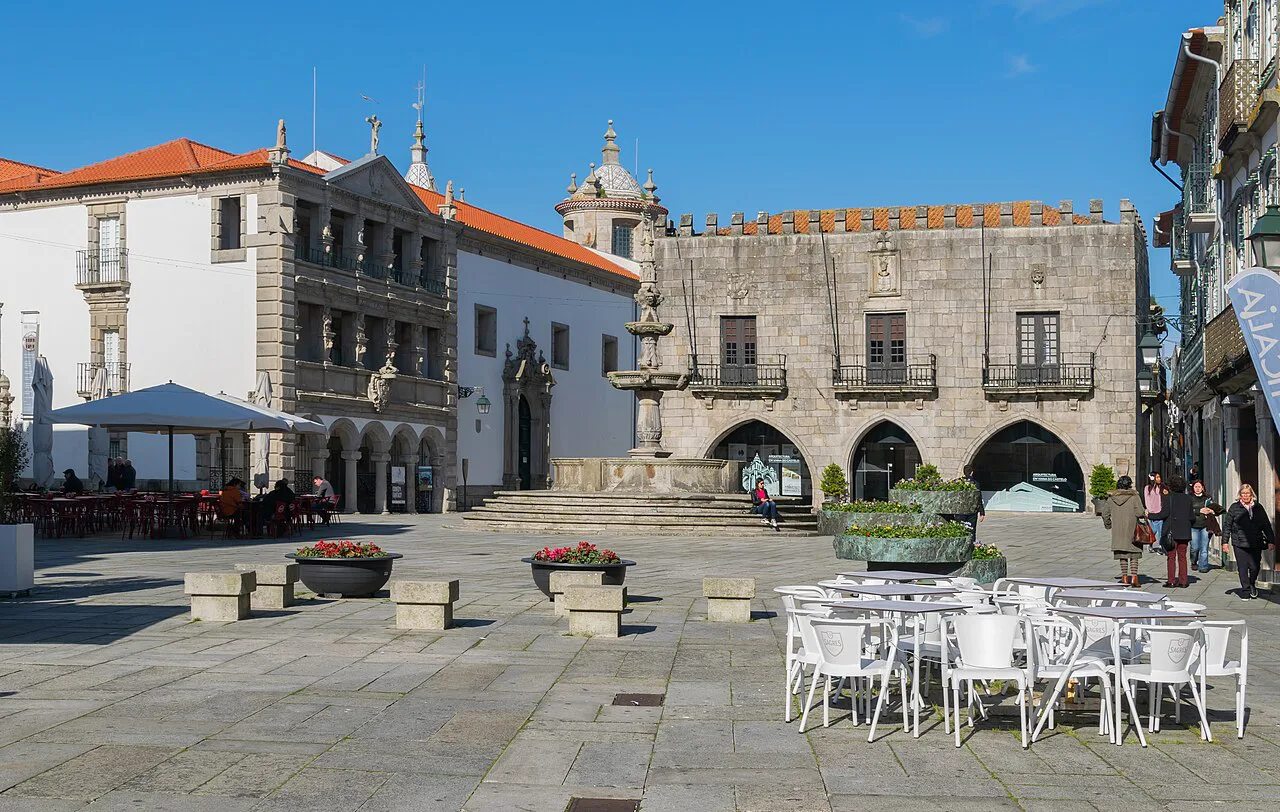
Praça da República lies within the perimeter of the old muralhado, the walled burgo, close to the Sé. The city council's heritage entry places the chafariz at the centre of the square, the old Praça da Rainha, beside the old walled town and a few metres from the former burgo gate area — which is exactly how it feels on the ground, as lanes converge on it from several directions.
That position is the practical reason to come. You are not detouring to a square on the ring road; you are passing through the densest part of the historic centre, where the streets are narrow enough to slow you down. Approach from the riverside or from the cathedral side and the square appears as a widening of the lanes rather than a formal set-piece.

How to get there on foot from the main sights and the station area
Walking is the sensible way in. From the station area the route runs downhill into the centre and then into the old lanes; from the riverside you climb gently inland towards the Sé. Viana do Castelo is compact enough that the square works as a waypoint on foot between the waterfront, the cathedral and the shopping streets, so you rarely need transport for this leg.
If you are coming from the hilltop Santuário de Santa Luzia, the descent by the elevador de Santa Luzia Viana do Castelo or by road drops you back into the lower town, from where the old centre is a short walk. Plan the square for the middle of a walking loop rather than a separate trip, and you save both time and shoe leather.
The chafariz at the centre of the square
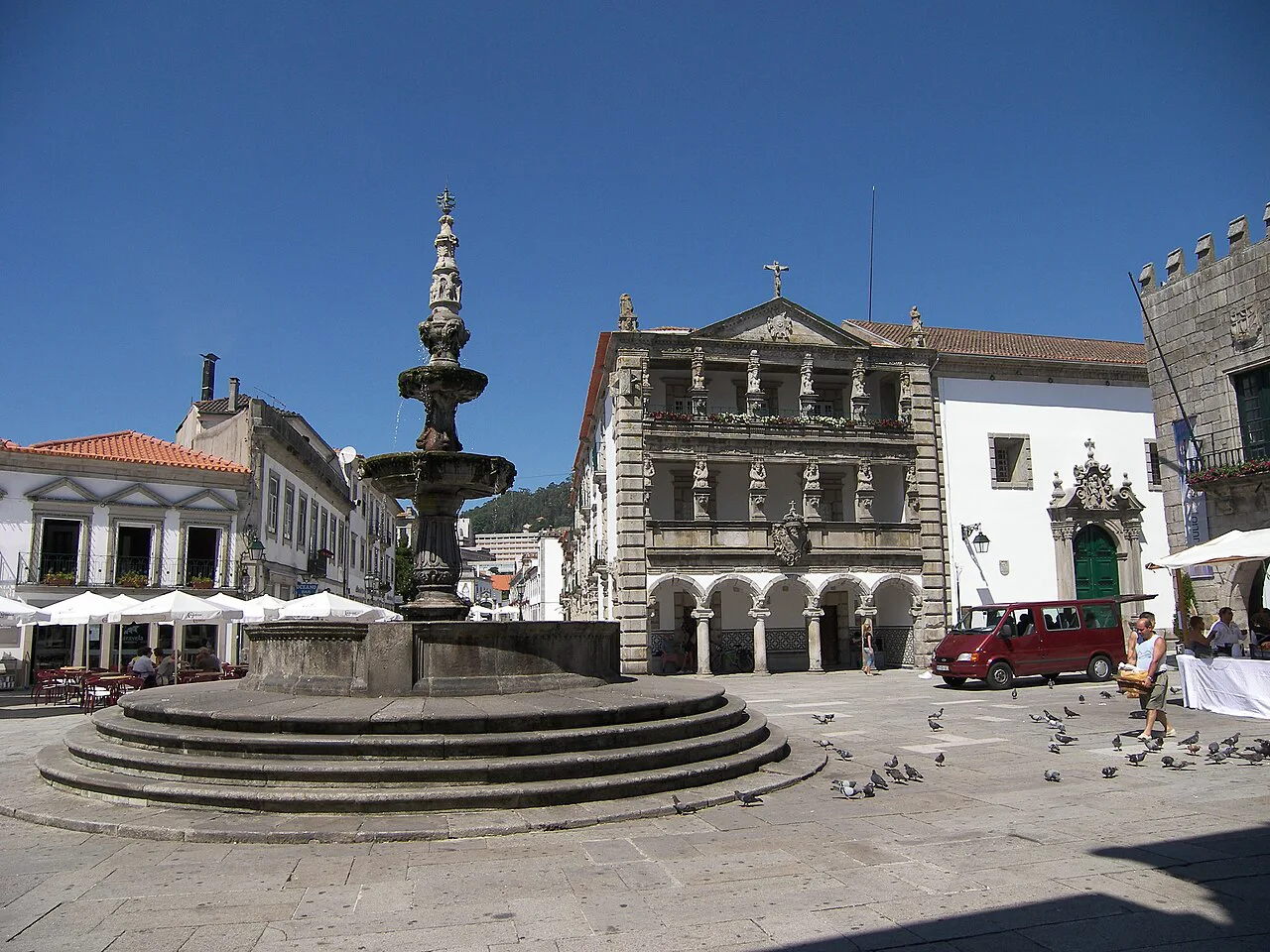
The fountain, or chafariz, is the square's anchor and the thing most visitors photograph. The city council describes it as standing at the centre of Praça da República, the old Praça da Rainha, which makes it a useful landmark when you are navigating the lanes: find the water and you have found the square.
Look at it as civic furniture rather than a monument to tick off, and the square makes more sense: fountains like this were the practical heart of a neighbourhood, and the buildings around it were arranged to face the water. There is no ticket to see it and no queue, so slot it into a walk rather than scheduling it.
Earlier names: Campo do Forno and Praça da Rainha
The square has changed names more than once, which is a small clue to how the city grew around it. It has appeared as Campo do Forno and later as Praça da Rainha before taking its current name, so you may still see the older forms on plaques, maps or in local writing.
Knowing the earlier names helps when you are cross-referencing an old map or a heritage panel. It also explains why the square feels domestic rather than grand: it served a neighbourhood before it served visitors. The change of names is history, not a practical detail you need to act on, but it makes the ten minutes more interesting.
The buildings and cafés around the square
The square is ringed by old commercial buildings and cafés that keep it busy through the day. It holds three monuments around the space, and the ground-floor premises facing the fountain are a mix of shops, cafés and old houses rather than a single, formal frontage.
Treat any café you fancy as a pick to check on the ground rather than a guaranteed stop: tenants on a square change, and what is trading when you visit is worth confirming before you commit to a table. What you can count on is the pattern, a ring of low buildings with a café or two facing the fountain, which is the reason to linger rather than just photograph and leave.
How much time to allow and the best moment to see it
Budget ten to fifteen minutes for the square itself, or closer to forty-five if you take a table and order something. The best moments are the softer ends of the day, when the light falls across the façades and the square is busy with locals rather than coach groups. Midday in high summer is hot and exposed, so use the square as a shaded pause rather than a long stop.
If your short break runs to one or two days in the city, the square slots naturally into a morning loop of the old centre and a late-afternoon return for a drink. It is small enough that you can pass through it twice without feeling repetitive, and that is the point of a hinge.
Nearby: the Sé, the old lanes and the riverside
The obvious pairing is the Sé de Viana do Castelo, a few minutes away, followed by the lanes between the cathedral and the river. The Igreja da Misericórdia in Viana do Castelo and the Igreja de São Domingos, Viana do Castelo give you two more churches within the same walking radius, so you can build a church-and-lanes morning without getting back in a car.
For a change of register, the Museu de Artes Decorativas, Viana do Castelo and the Museu do Traje Viana do Castelo are indoor options that pair well with a square visit on a wet or very hot day. Further out, the Forte de Santiago da Barra, Viana do Castelo sits on the river side of town and works as the end point of an old-centre-to-waterfront walk.
The wider city has two set-piece sights that frame any short break: the Ponte Eiffel in Viana do Castelo, which you cross or view from the banks, and the Santuário de Santa Luzia on the hill above. Neither is a substitute for the old-town lanes, but together they give the square a shape in your day: hill in the morning, lanes and square in the afternoon, bridge and river at dusk.
Practical notes: opening hours and prices
The square is public space, so there is no entrance fee and no opening hours to plan around; you can walk through it at any time of day. Costs only arise if you sit at a café or buy something, and those prices are set by the individual businesses rather than the square.
For any heritage building you might combine with the visit, times and ticket prices vary by venue and season, so check the venue's own notice or the council's heritage pages before you set out. That is the one check worth making in advance, because a closed museum turns a tidy walking loop into a longer diversion.
Is Praça da República worth the stop?
Yes, as a ten-minute pause on a walk through the old centre, not as a destination in its own right. Come for the chafariz and the ring of old shopfronts, then spend your real time on the lanes and churches around it.
If you have only one day, use the square as the seam between the Sé and the riverside; if you have two or three, add the hilltop sanctuary and the bridge and come back to the square for a late coffee.