
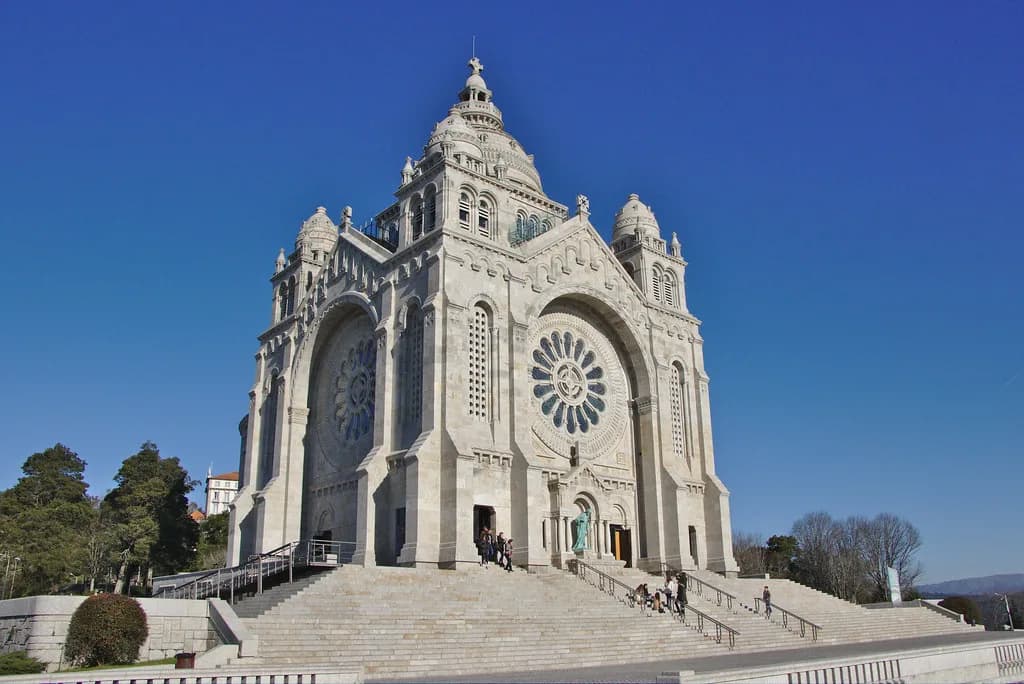
Santuário de Santa Luzia: Viana do Castelo's Hilltop Church
Give the Santuário de Santa Luzia two hours, and come for late afternoon if you want the estuary light on the way down. The church on Monte de Santa Luzia is the city's emblem, visible for kilometres, and the visit splits neatly into three parts: the granite temple itself, the climb into the dome, and the garden and picnic ground beside it. This guide covers what is inside, how the published hours work across the seasons, how to get up the hill and what sits close enough to pair with it.
One thing to settle before you go: the temple is dedicated to the Sagrado Coração de Jesus (Sacred Heart of Jesus), not to Santa Luzia, even though the hill, the popular name and the brotherhood that built it all carry hers.
What the Santuário de Santa Luzia is
The building is formally the Templo-Monumento do Sagrado Coração de Jesus, a diocesan sanctuary run by the Confraria de Santa Luzia on the hill above the city. The brotherhood frames it as the work that became Viana do Castelo's calling card, and the temple stands on the summit as the city's most recognisable landmark. Its position, rather than any single treasure inside, is what makes it worth an afternoon.
In 2020 the Bishop of Viana do Castelo elevated the temple to diocesan sanctuary, and the Portuguese bishops approved a candidacy for it to become a minor basilica. That is the accurate state of its title: a sanctuary, with a basilica petition on record. If the label matters to you for a wedding, baptism or parish request, ring the brotherhood rather than relying on older guidebooks.
The sanctuary receives around a million people a year, drawn by the panorama as much as by the liturgy. Practically, that means the mount is busy on fine weekends and quiet on grey weekday mornings, when the church interior is easiest to look at properly.

Where it sits above Viana do Castelo
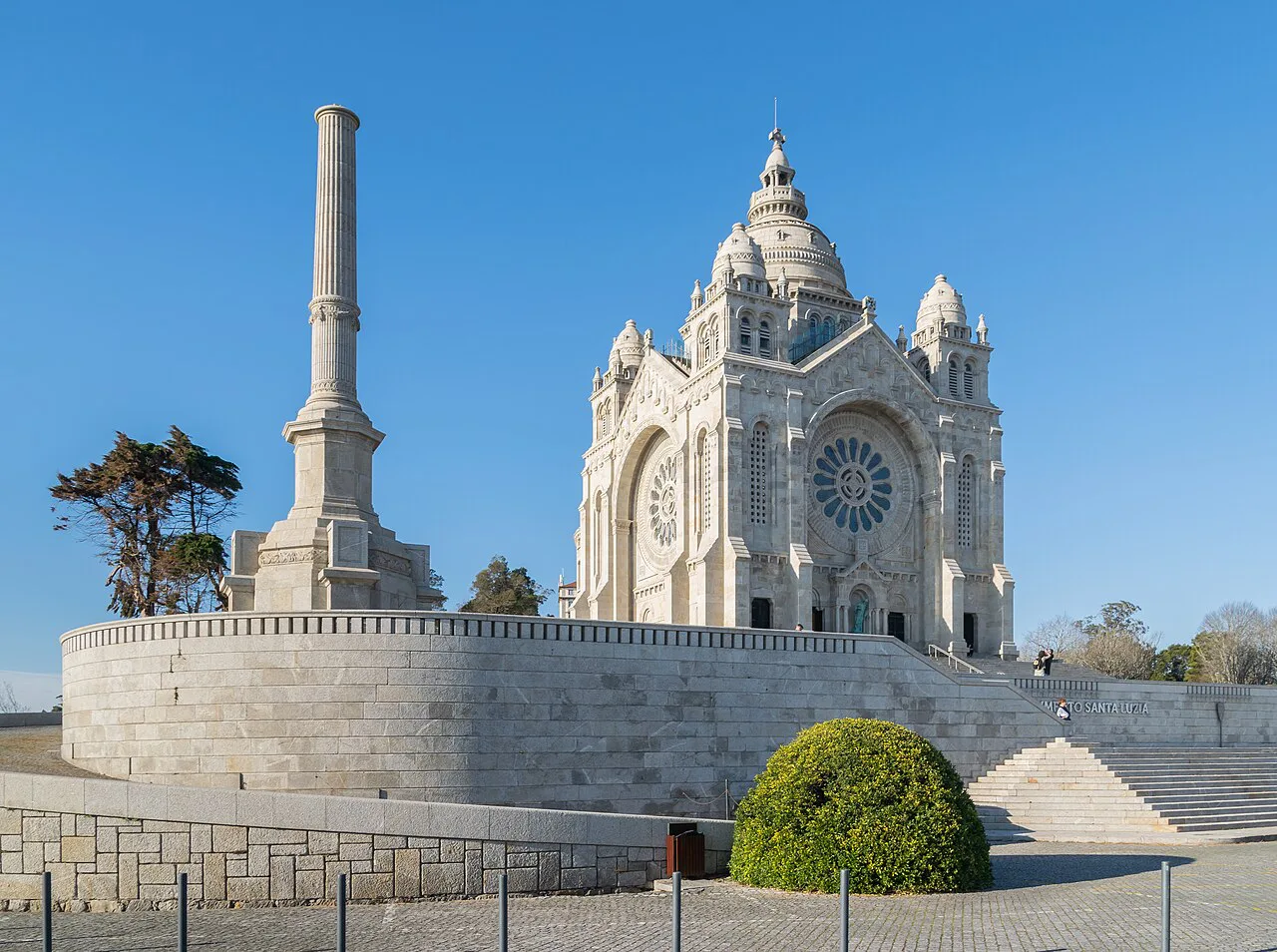
Monte de Santa Luzia rises on the northern edge of Viana do Castelo, and the temple stands roughly 228 metres above sea level, crowning what locals call the Princesa do Lima. From the terrace the view runs out over the Lima valley to the estuary directly below the city, with the Serra de Arga on the northern side and Ponte de Lima visible in the far distance on a clear day. Allow a few minutes just to orientate yourself against the river before going inside.
Because the hill sits immediately above the town, you can walk from the centre to the sanctuary without any transport at all, though the ascent is steady rather than gentle. For the wider picture of what the city holds, from the old-town squares down to the riverfront, see the full set of Viana do Castelo Attractions guides.

How to get up the hill: walking or the funicular
There are two honest choices. Walking up through the wooded approach costs nothing and lets you arrive on foot through the trees, but it takes effort and you will want to pace yourself on a warm day. The alternative is the Elevador de Santa Luzia, the funicular that covers the climb itself, useful when time is short, when legs are tired or when the weather is closing in.
Whichever way you go up, check the operating pattern before committing to the funicular as your return leg, since a seasonal timetable decides your descent as much as your ascent. Our guide to the Elevador de Santa Luzia covers the practical side of the ride.
Opening hours for the church, shop and dome
The church keeps seasonal hours rather than a single year-round schedule: from April to October it opens daily from 9am to 6pm, and from November to March daily from 9am to 5pm. The souvenir shop follows the same pattern. Plan the temple for the middle of that window and you will not be hurrying.
The dome climb, the cimborrio, keeps its own hours through the lift: in summer the lift runs from 9am to 6.45pm and in winter until 4.45pm, with a symbolic charge rather than a set published price. Take the dome first if you arrive late in the day, since it closes earlier than the church itself.
Mass is celebrated Tuesday to Sunday at 4pm, with an extra Sunday Mass at 11am. If you want the church without a congregation, aim for a weekday morning rather than the mid-afternoon slot.
What to see inside the temple
The plan is a Greek cross with a Byzantine root, which produces the enormous central dome and the four smaller cupolas on the towers. Look up as soon as you are past the door: the interior is built around that vertical axis, and the granite stonework of the region is visible throughout, carved by local masons under the direction of Emídio Pereira Lima.
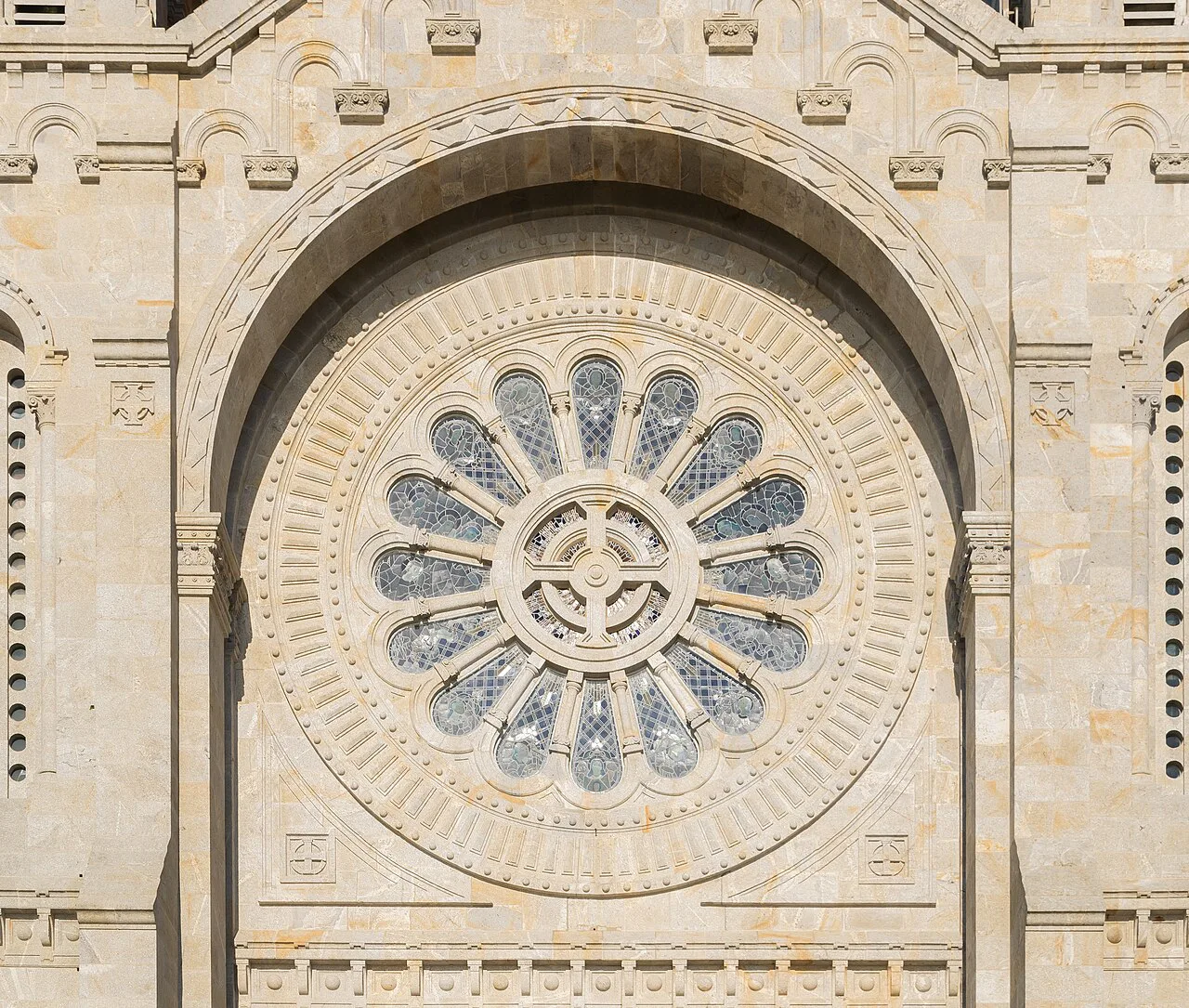
The rose windows are the set-piece of the facade, the largest in the Iberian Peninsula, framing the stained glass that colours the interior. Inside, two angels by Leopoldo de Almeida present the shields of Portugal and of Viana do Castelo to the Sacred Heart, with the central figure a marble copy of the bronze statue at the entrance, carved from Vila Viçosa marble by Martinho de Brito.
Devotion inside is layered. The image of the Sacred Heart came from the Convento dos Crúzios, the Santa Luzia image moved here from the chapel that stood on the hill before the temple, and a statue of Nossa Senhora de Fátima serves pilgrims who come for her. That mix explains why visitors hear the hill called Santa Luzia while the dedication above the door names the Sacred Heart.
Climbing to the cimborrio for the 360-degree view
The dome climb is the reason many people come up the hill at all: from the cimborrio the panorama opens to a full circle, taking in the valley, the estuary, the city roofs and the Serra de Arga in one sweep. Allow around twenty minutes at the top once you have queued for the lift. It is also the one part of the visit with a charge, so have a little change ready.
Skip it without guilt if the day is hazy or you are short of time; the terrace in front of the church already gives you the estuary view for nothing. The dome adds height rather than a different scene.
The Jardim dos Tilos and picnic ground
Beside the temple, the Jardim dos Tilos gives you a calm garden to walk through, and there is a designated picnic area if you have brought food up with you. This is the part of the mount to use for a slow half hour after the church rather than before it.
There is a café and shop on site for a drink or a souvenir, which saves you carrying everything up the hill. Opening follows the church seasons, so a winter visit ends earlier than a summer one.
The story in brief
The architect Miguel Ventura Terra designed the temple and work began in 1904; after his death his disciple Miguel Nogueira took over, the exterior was finished in late 1943 and the interior in 1959. The result is a twentieth-century building in Romanesque-Byzantine dress, sometimes compared to the Sacré-Coeur in Paris, which surprises visitors expecting a medieval church.
The city's bond with the temple dates to 1918, when Viana do Castelo was consecrated to the Sacred Heart during the pneumonic flu pandemic, with a promise of an annual pilgrimage up the hill if the outbreak ended. That pilgrimage still takes place each year on the Sunday nearest the feast of the Sacred Heart, and it is the busiest day to avoid if you want a quiet visit.
Why the hill carries Santa Luzia's name
Santa Luzia is associated with sight, and the sanctuary's own account ties the devotion to a cavalry captain, Luís de Andrade e Sousa, who asked for her help with an eye condition and founded the Confraria de Santa Luzia after recovering. That is why people still come to the hill to give thanks for their eyes as much as to see the view.
So the naming is not a mistake: the temple belongs to the Sacred Heart, the hill and the brotherhood to Santa Luzia. Read the dedication panel inside and you will see both strands held together.
What is nearby on the same trip
Down in the city, the Ponte Eiffel Viana do Castelo carries the railway across the Lima and is worth a look on the walk back from the hill. Pair it with the old-town squares for a half-day that starts high and ends at river level.
For a different kind of visit, the Museu do Traje, Viana do Castelo explains the costumes you will see during the Festas da Agonia, and the Praça da República, Viana do Castelo is the natural pause in the old centre within easy reach of the riverside. Both work as the second stop of a day that began on Monte de Santa Luzia.
If you have a car or a spare hour, the Forte de Santiago da Barra, Viana do Castelo guards the river mouth on the coastal side of town, a short drive or a longer walk from the centre. It gives you the estuary from sea level to set against the view from the mount.
Two churches in the centre round out the religious side of the visit: the Igreja da Misericórdia, Viana do Castelo and the Igreja de São Domingos, Viana do Castelo are both within the old town, and the Museu de Artes Decorativas, Viana do Castelo adds a domestic interior to the day if you still have energy.
Is the climb worth the detour?
Yes, if you go for the combination rather than the building alone: a twentieth-century temple with the peninsula's largest rose windows, a dome view over the Lima estuary and the Serra de Arga, and a garden for a slow half hour. Two hours on the mount is enough, three if you walk both ways and stop for coffee.
Check the seasonal hours on the Confraria's site before you set out, and ring the brotherhood on +351 258 823 173 if you need to confirm the dome lift or a service. The dome climb carries a small charge.
Frequently Asked Questions
O que Santa Luzia protege?
Santa Luzia is associated with sight, and the devotion on Monte de Santa Luzia grew from a thanksgiving for restored eyesight. The cult is tied to the hill and the Confraria de Santa Luzia, while the temple itself is dedicated to the Sagrado Coração de Jesus.
Onde fica a imagem original de Santa Luzia?
The Santa Luzia image now venerated in the temple was brought there from the chapel that stood on the hill before the present building was erected. It sits alongside the image of the Sacred Heart, which came from the Convento dos Crúzios.
When is the Santuário de Santa Luzia open?
The church keeps seasonal hours: from April to October it opens daily from 9am to 6pm, and from November to March daily from 9am to 5pm. The dome lift runs to 6.45pm in summer and 4.45pm in winter, and carries a small charge.