Évora Roman Temple: What You'll See and How Long You Need
See the Roman Temple in Évora, known as the Temple of Diana, with its Corinthian columns, and learn what else survives from Roman Évora.
On this page
The Roman Temple in Évora is a short stop, not a half-day sight: most travellers give it fifteen to twenty minutes, because what stands today is a single colonnade on a stone platform rather than a complete building. It sits in the middle of the historic centre, so it works best as one fixed point on a walk rather than a destination in itself. This guide covers what actually survives, where the temple sits, how the Diana name arose and which other Roman traces are worth hunting down.
What the Roman Temple in Évora is
The structure is a Roman forum temple from the 1st century, raised in the time of Caesar Augustus and dedicated to the emperor as a god. It was altered in the 2nd and 3rd centuries, damaged during the Barbarian invasions of the 5th century, and its original design was only recovered in the 19th century. Amiroad describes it as Portugal's best-preserved piece of ancient Rome, which is the fairer label than calling it the country's best-preserved temple.
The popular name Templo de Diana comes from a later association with the Roman goddess of hunting, not from any original dedication; an audio guide for the site goes further and calls the Diana name erroneous. Treat the nickname as shorthand you will see on signs and in listings, and the formal name as Templo Romano de Évora. Either way, you are looking at the legacy of the Roman forum that once anchored this hilltop.
Where it sits in Évora's historic centre
The temple stands within the Évora old town, the UNESCO-listed upper city, a few minutes' walk from Praça do Giraldo, the cathedral and the Roman baths beneath the town hall. Because the streets around it are narrow and the monument sits within a small square rather than on a grand avenue, it can be easy to pass without noticing until you are almost on top of it — so approach slowly and look up for the columns against the sky.
Everything in this upper section is walkable: from the temple you can reach the Sé, the Capela dos Ossos and the Praça do Giraldo in under ten minutes each, which is why the temple rarely justifies its own trip across town. Build it into a loop of the centre rather than treating it as a separate outing. If you want the streets and stories ordered for you, an Évora walking tour can do that job.
The twelve Corinthian columns and what survives
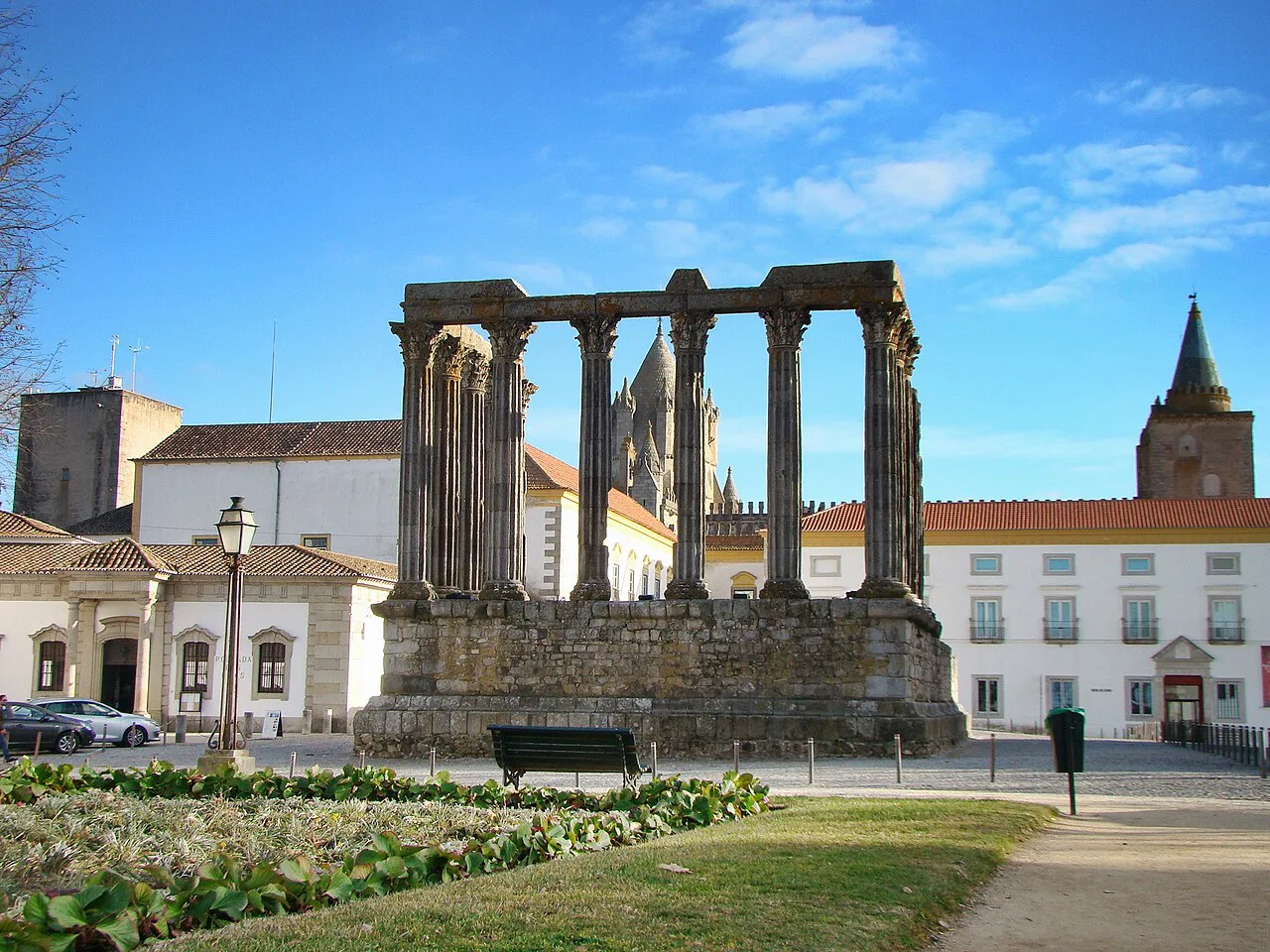
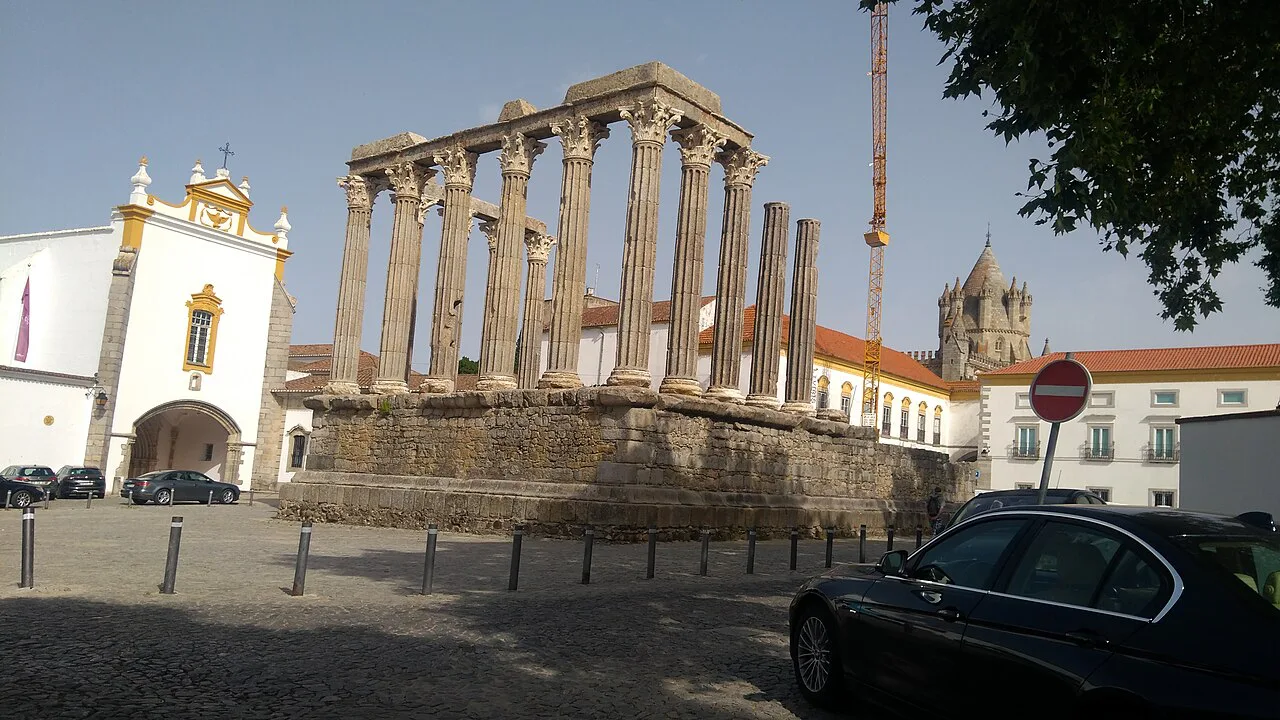
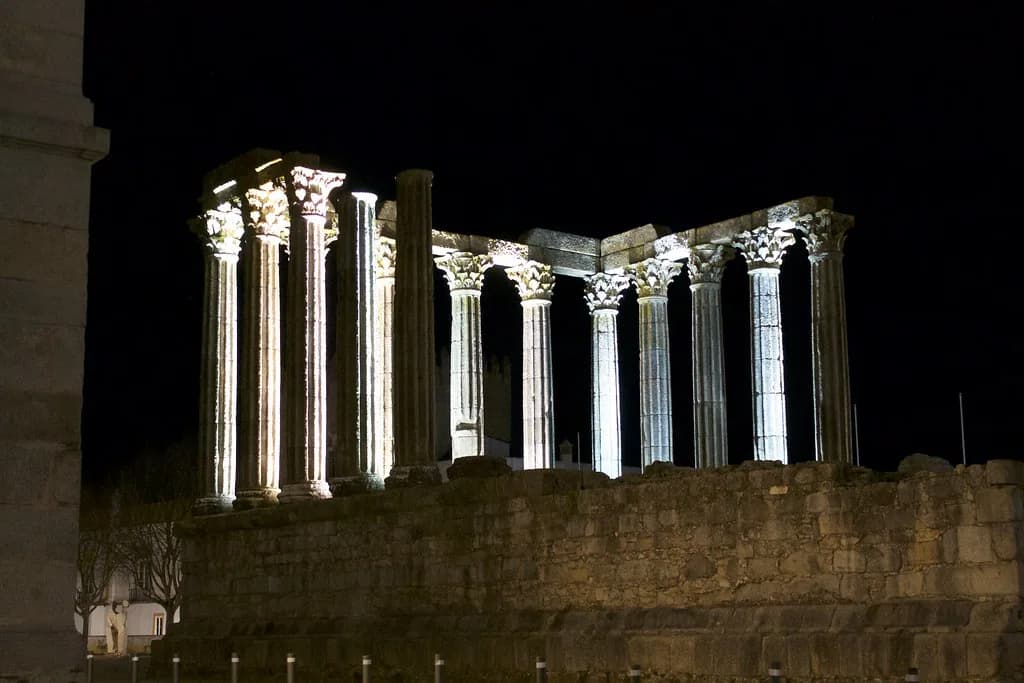
What you see is a row of twelve Corinthian columns of local stone, still carrying part of their entablature and standing on a raised stone podium. The tall shafts and carved capitals give a clear sense of the scale of the original forum temple, and the podium is the part that makes the ruin legible as a building rather than a scatter of masonry. Tripadvisor reviewers consistently call it small but authentic, a 2,000-year-old ruin with parts still intact, so adjust expectations accordingly.
The lost parts matter to how you read the site: it was destroyed during the Barbarian invasions of the 5th century and its original design was only recovered in the 19th century, so what stands today is a surviving fragment of a larger forum temple rather than a rebuilt one. That is why the monument reads as sculpture in a square rather than an enclosed interior you can enter. Visit early or late in the day, when the light rakes across the columns.
How long to spend and whether you need a ticket
Fifteen to twenty minutes is realistic: a slow circuit of the podium, a look at the columns from both long sides and a few photographs. There is no interior to tour and no exhibition on site, so the time you spend is mostly about reading the structure and enjoying the square around it. Anyone with a serious interest in Roman architecture will linger longer over the capitals; everyone else will be done quickly.
The temple stands in an open square, and little more than an open-air look is needed to see it; no ticket is required simply to view it from the square, but access arrangements around the monument can change, so confirm on the day before building a plan around it. The remains of the Roman baths beneath the town hall are a separate visit with their own arrangements. For a wider set of indoor options, the Museums in Évora guide covers what is open and what each collection holds.
Other Roman remains to look for in Évora
The Roman baths sit under the town hall near the Praça do Giraldo, and the city's Roman walls and aqueduct are woven into later buildings rather than presented as monuments. Look for reused stonework in the medieval walls and church fabric, where Roman blocks were recycled over the centuries. The aqueduct is the other substantial piece of the Roman legacy, running out beyond the old centre; the Évora history guide sets the Roman layers alongside the Visigothic and Moorish ones.
If Roman masonry is your priority, pair the temple with the baths and the cathedral in a single morning, since all three sit within a few minutes of each other. The Évora Cathedral (Sé) guide explains the church's mixture of Romanesque and later Gothic work, including stone reused from earlier buildings. Azulejos in Évora covers the tiled interiors that come later in the city's story, a useful contrast to the bare granite of the temple.
How the temple fits into a one-day walk through Évora
Start at the Praça do Giraldo, climb through the old town to the temple, then continue to the cathedral and the Capela dos Ossos before dropping back down for lunch. That order keeps the Roman temple early, when the square is quieter, and leaves the longer indoor visits for the middle of the day. Allow about twenty minutes at the temple and roughly half a day for the whole upper-town circuit.
Because the temple can be viewed from the square without a ticket, it belongs on any low-budget itinerary; the free things to do in Évora guide lists it alongside other no-ticket stops in the centre. If time is short, the temple and the cathedral are the two sights to keep, and the museum collections can wait for a longer stay. The things to do in Évora guide links every major sight in one place for building the rest of the day.
Is the Roman Temple worth the detour?
Yes, with the right expectations: it is a ten-to-twenty-minute stop, viewable from the open square without a ticket, and the most tangible piece of Roman Évora left in the city. Go early or late for the light, read the twelve columns as the surviving face of a forum temple, and treat the Diana name as a nickname rather than a dedication. Build the rest of the day around the cathedral, the baths and the tiled interiors nearby.
Frequently Asked Questions
Are there Roman ruins in Portugal?
Yes. Évora's Roman Temple is the best-known in the Alentejo, and the city also keeps Roman baths, wall fragments and an aqueduct. Elsewhere in Portugal, Roman sites such as Conímbriga draw visitors, but within Évora the temple, baths and walls are what you can see on foot.
What is the history of the Chapel of Bones in Évora?
The Capela dos Ossos is a later addition to the city's story, built with human remains and decorated interiors rather than Roman stone. It sits close to the Roman Temple in the upper town and pairs naturally with a visit, but it is a separate monument with its own arrangements, so check locally before you go.
What is the most famous Roman temple?
In Évora, the Templo Romano de Évora, widely called the Temple of Diana, is the city's signature Roman monument and the one most travellers come to see. It is a forum temple from the 1st century, and its twelve Corinthian columns are what most photographs show.
Sources
Notes for your next Portuguese break
Optional updates to our town guides.
You might also like
Continue reading
More guides you'll find useful