Best Towns in the Alentejo: 10 Places Worth Your Short Break
The best towns in the Alentejo, chosen for what they give a short-break traveller: Évora, Monsaraz, Marvão, Elvas, Estremoz and the coast, with honest trade-offs.
On this page
For a short break, pick Évora first and build the rest around a car: it is the only Alentejo town with a direct train line from Lisbon, and it holds two thousand years of history inside medieval walls. Almost everywhere else in this guide is a drive of one to three hours from Évora or Lisbon, so the real choice is which direction to point the car. The towns below are grouped by the decision each one demands: walled village, marble town, border fortress or coast.
The Alentejo makes up almost all of southern Portugal beyond the Tejo river, but it holds only a small share of the country's population, which is why the towns are small and the spaces between them are long. That emptiness is the appeal and the practical problem: you cannot nibble at five towns in three days without spending the trip behind the wheel.
How far apart are the Alentejo towns?
From Lisbon you can reach Évora in about an hour and a half by car on the A2 and A6, and a similar time by train; the crossing into the Alentejo begins within twenty or thirty minutes of the city. Hilltop Monsaraz sits about fifty-five minutes beyond Évora, and the Spanish border towns are a further push east. That geometry matters: Évora is a natural hub, and every other town is a spur from it.
Buses and trains reach the main hubs, with Évora as the clear centre of the network, but the small hilltop villages generally demand four wheels. Trains run several times a day between Lisbon and Évora, while the bus network fills in the rest. If you are travelling without a car, treat Évora as your whole trip rather than a launchpad.
How to choose: village, marble town or fortress
Three types of Alentejo town reward different travellers. The walled hilltop villages — Monsaraz, Marvão — are tiny, worth a few hours for the walk, the castle and the view, so the day is really about the drive and the landscape. The marble towns of the Estremoz–Vila Viçosa axis give you palaces, churches and craft, while Évora alone gives you enough for two full days. If you want coast as well, remember that the Costa Vicentina is a separate trip: you cannot do border fortresses and Atlantic beaches comfortably in four days.
Évora: the one town that works without a car
Évora is the obvious base and the strongest single stop in the region. Its UNESCO-listed centre sits almost entirely inside medieval walls, packed with squares, parks, churches, a Roman temple and a grand cathedral you can walk between on foot. It is roughly 131 km east of Lisbon, so it fits neatly into a long weekend without eating a day in transit.
There is plenty to do beyond the headline monuments: traditional sweets, good restaurants, museums and local shopping. The practical trade-off is that Évora is the most visited place in the region, so it feels busier than the villages; that convenience is exactly what you are paying for. Stay here and you can see the city and still day-trip to Monsaraz or Arraiolos.
Monsaraz: hilltop castle and Alqueva lake views
Monsaraz is the postcard Alentejo: a handful of slate-paved streets, whitewashed houses, a castle and somewhere around thirty permanent residents. Two hours and ten minutes by car from Lisbon, or about fifty-five minutes from Évora, it is a short visit that lands hard, and the empty lake country around it is the point. Come for the late light and the view over Alqueva Lake, the largest artificial lake in Europe, rather than for a list of sights.
Down the hill, São Pedro do Corval is Portugal's pottery village, with almost two dozen family workshops turning red terracotta into plates, jugs and cups, often workshop and shop in one room. Any doorway marked olaria is worth a look. Pair it with Monsaraz for a full day that mixes craft with the fortress view.
Marvão: the border village inside a protected reserve
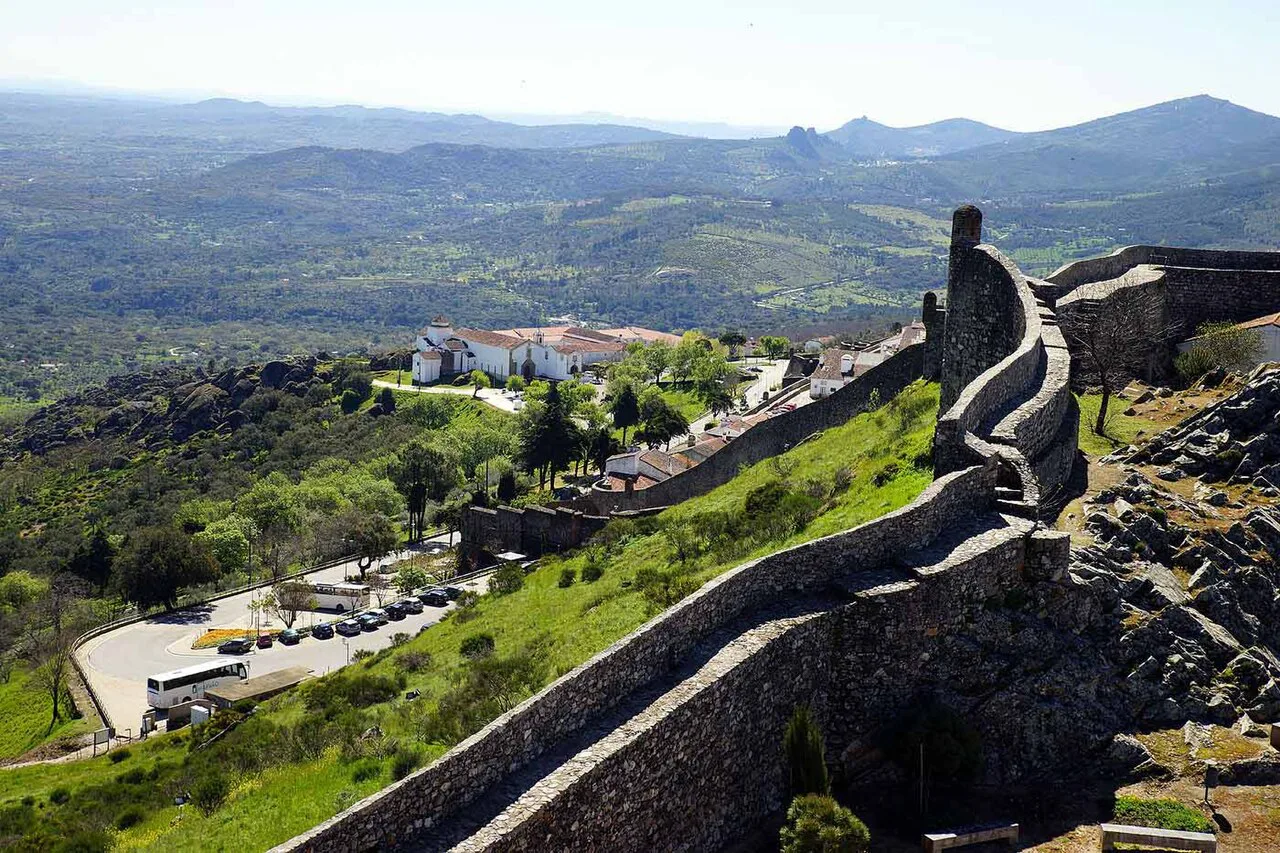
Marvão is another hilltop settlement, a medieval village that sits inside a protected natural reserve, which makes the approach as good as the arrival. It belongs to the Alto Alentejo, the northernmost slice of the region, where mountains and medieval villages look across towards the Serra da Estrela. Budget a half-day; the walk is short and the views do the work.
Elvas: the fortified border town
Elvas is the border fortress town, closer to Spain than to Lisbon, and its appeal is the sheer scale of its walls and outworks. It suits travellers who like military engineering and layered history rather than shaded squares and cafés. Because it sits far east, it pairs badly with the coast and well with Marvão or Estremoz.
Estremoz: marble, the marble tower and the old town
Estremoz is the Alentejo's marble town, and its reputation rests on the tower and the older quarter built from the stone. Spend your time in the old town rather than the newer streets, and treat it as a half-day stop on the way between Évora and the border. If marble and palaces interest you, a fuller guide to Estremoz covers the Paço Real and the Castle of Estremoz in detail, and for the tilework that decorates so many Portuguese interiors, see this guide to azulejos in Portugal.
Vila Viçosa: the Ducal Palace and the marble country around it
Vila Viçosa is the second half of the marble axis and the grander of the two, with the Paço Ducal at its centre. The town is small enough to see in a morning, which makes it a good pairing with Estremoz on the same day. For the palace, the marble streets and the practical details, work from the guide to Vila Viçosa before you set out.
Arraiolos: rugs and a quiet square
Arraiolos is famous for two things — its embroidered rugs and its pies — and it is quiet enough to feel like a rest day between bigger stops. It is a sensible half-day from Évora, and the craft is the reason to come: you can watch and shop without a crowd. Read more on Arraiolos if the needlework is what draws you.
Mértola: Islamic roots above the Guadiana
Mértola sits by the Spanish border, and its identity is its Islamic past, which runs through the street plan and the buildings. It is one of the strongest reasons to push south-east, and it pairs with Serpa and Beja on a Lower Alentejo run rather than with the marble towns. Give it a half-day and leave time to wander.
Beja: the rural capital with Roman roots
Beja is the working capital of the Lower Alentejo, with Roman foundations and a castle at its heart. It feels like a real town rather than a stage set, which is precisely its value after a run of tiny villages. The guide to Beja, Portugal sets out the castle, the convent and the streets worth your time.
Nearby Serpa is known for its cheese and a slower pace, and it slots neatly into a day with Beja. Neither is a headline stop, but together they round out a Lower Alentejo route. The Serpa guide covers the town and what to see.
Coastal alternatives: Alcácer do Sal, Porto Covo and Vila Nova de Milfontes
If you want Atlantic air, the Alentejo coast is a different trip from the inland towns, not an add-on. Alcácer do Sal brings rice fields and a castle, Porto Covo is the small coastal stop, and Vila Nova de Milfontes is where the river meets the sea. All three mean committing your short break to the coast.
The Costa Vicentina's beaches are wild and uncrowded, which is the reason to choose this side. The trade-off is straightforward: choose coast and you give up the border fortresses and the marble axis. Pick one side of the region for a four-day trip.
Which towns combine well into a two-, three- or four-day route
Two days means Évora only, on foot, with no hire car. Three days adds a day loop from Évora to Monsaraz and the pottery village of Corval, or to Arraiolos if you want craft rather than views. Four days lets you drive Évora to Estremoz and Vila Viçosa and finish near Elvas or Marvão, though the driving at the eastern end is the longest leg.
A common short-break mistake is treating the Alentejo like a day-trip zone from Lisbon. The region covers almost thirty per cent of the country, so every extra town costs hours in the car. Choose fewer towns and stay two nights in each base.
How many days does each town need?
Évora needs two full days; the walled villages of Monsaraz and Marvão need a few hours each; Estremoz and Vila Viçosa fit into one day between them; Beja, Serpa and Mértola can share a two-day loop if you are heading south. Arraiolos is a half-day. The coast wants at least two nights on its own.
Add travel time honestly: a hilltop village an hour away eats a large part of a day when you count the drive out and back. If you have only three days, Évora plus one hilltop loop is a better trip than four towns in a blur. Use the smaller stops as breaks between bigger ones, not as a checklist.
Should you base yourself in Évora or hire a car?
Base yourself in Évora and hire a car for one loop if you have three or four days. If you have less, skip the car altogether. The towns that justify the drive are Monsaraz, Marvão and the Estremoz–Vila Viçosa pair; the rest work as shorter pauses on a route rather than destinations in themselves.
Choose the coast only if you are willing to give up the inland towns entirely, because the distances rule out both. On the ground, the visitor pattern is a short city stop, a day of driving between small towns, and an unhurried last morning before heading back to Lisbon.
Explore more Portugal guides
Sources
Notes for your next Portuguese break
Optional updates to our town guides.
You might also like



Continue reading
More guides you'll find useful