
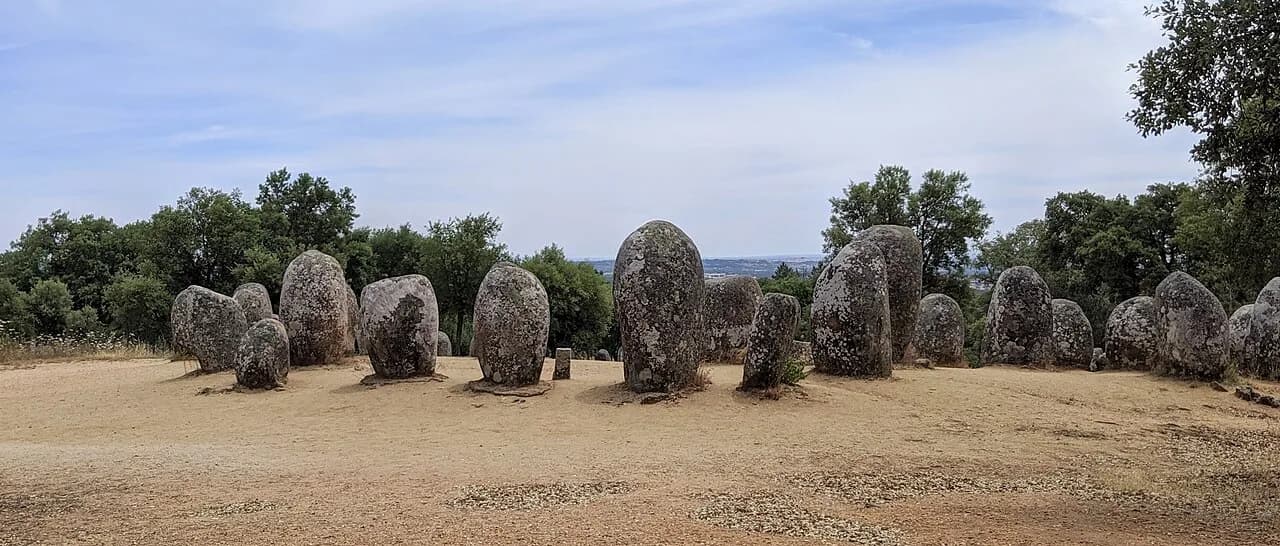
Megaliths in Portugal: Standing Stones Around Évora and Monsaraz
Megaliths in Portugal cluster around Évora and Monsaraz. Here is what the Almendres Cromlech, the dolmens and menhirs are, and how to fit them into a short break.
On this page
Portugal's megaliths are concentrated in the Alentejo around Évora and Monsaraz, where the Almendres Cromlech and a scatter of dolmens and menhirs sit in open farmland within easy reach of the city. This guide explains what each type of monument is, how the cromlech is laid out, and how to build the stones into a one- to four-day break in the region rather than treating them as a separate expedition.
The premise is straightforward: the stones are a half-day add-on to Évora, best seen with your own transport, and worth the detour because the monuments are genuine prehistoric structures in the landscape rather than reconstructed set pieces. Read the sections that follow for the practical shape of a visit.
What Portugal's megaliths are
Megaliths are prehistoric monuments built from large stones, and the three forms you meet in Portugal are the cromlech (a ring or arrangement of standing stones), the dolmen, called an anta in Portuguese (a chamber of uprights capped by a slab), and the menhir (a single standing stone). Recognising which is which before you arrive helps you read the landscape.
These are among the older surviving structures in Western Europe, built by farming communities during the Neolithic and Chalcolithic periods, and they belong to a wider Atlantic tradition that runs through Brittany, Ireland and the British Isles. The Alentejo's megaliths are best understood as part of that common culture rather than as an isolated Portuguese curiosity.
If you want the deeper story behind the people who raised them, and the later kingdoms that came after, our Portugal history overview covers the sweep from prehistory onwards. The stones remain the most direct physical contact you will have with Portugal's earliest settled communities.
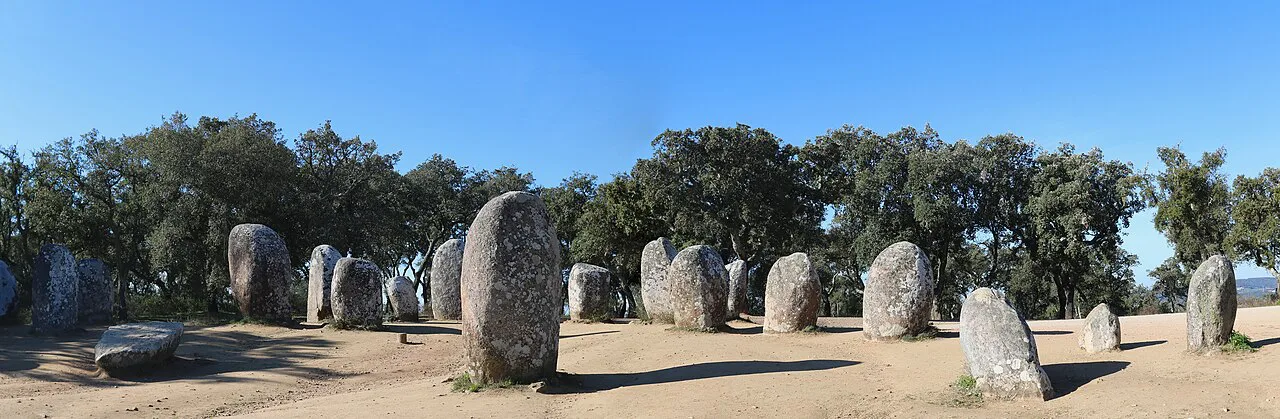
Where the stones are found
The main concentration sits in the Alentejo, in the countryside around Évora and towards Monsaraz and the Spanish border, where suitable stone for extraction was at hand. The Almendres Cromlech lies west of Évora, while the dolmens and menhirs are scattered across the same stretch of rolling farmland.
Megalithic monuments are distributed across Portugal more widely, with clusters recorded well beyond the Alentejo. Treat the Évora and Monsaraz area as the practical base for a short break, since it puts the cromlech, the dolmens and the walled hill town of Monsaraz within a manageable radius.
The phrase 'Al Gharb', the Arabic name for the land south of the Tagus, is a reminder that this landscape has a long later history on top of its prehistoric one. Our Moorish Portugal guide picks up that story several thousand years after the stones were raised.
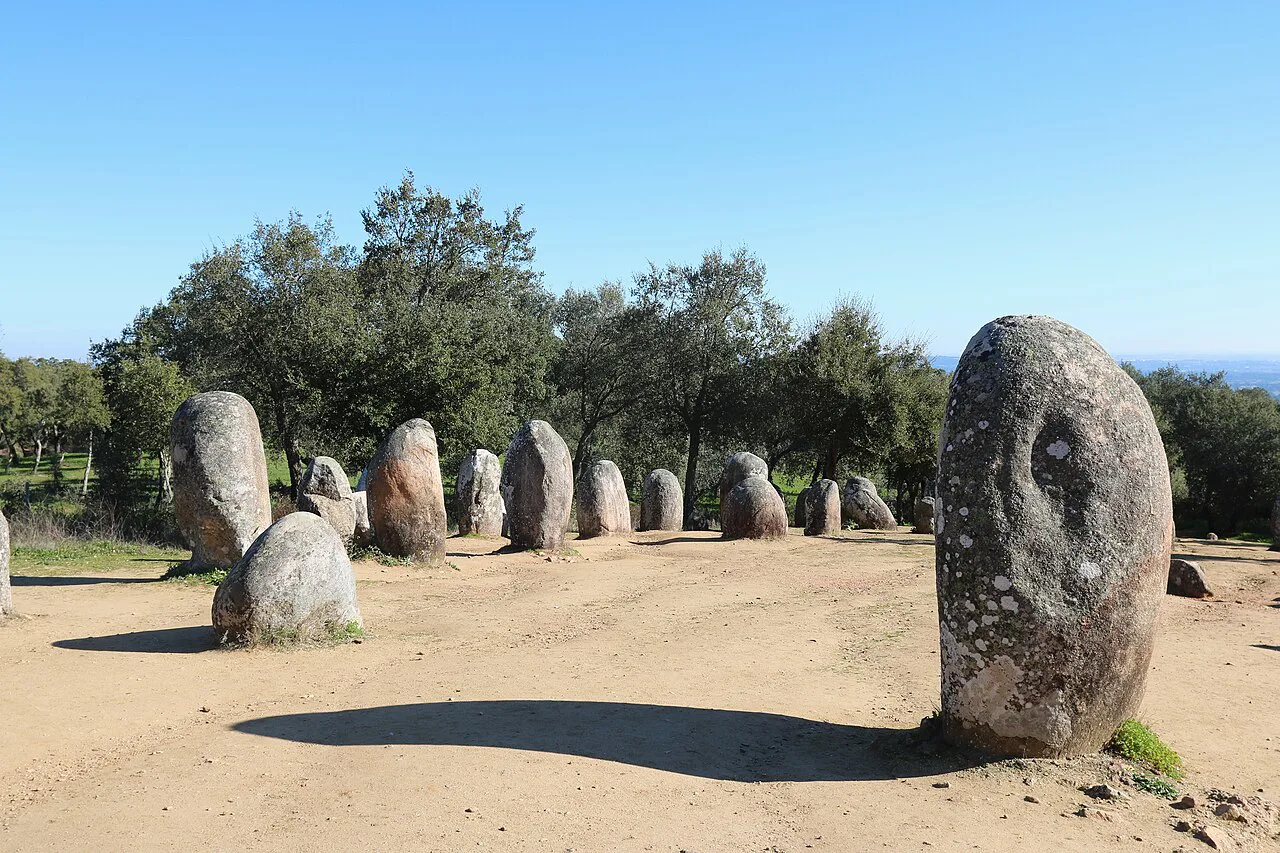
The Almendres Cromlech: what you see and how it is laid out
The Almendres Cromlech is the site most visitors come for: a large arrangement of standing stones set on a slope in the Évora countryside. The exact layout is best read on the ground, and walking round the outside of the group gives you a clearer sense of it than standing in the middle.
The site sits in open country rather than in a town, so the experience is largely unmediated: you approach through farmland and the stones are simply there. Wear shoes that cope with uneven ground and rough grass.
Because the cromlech sits in a working rural landscape, the conventional etiquette applies: close gates, keep to tracks where they are marked, and do not climb on the stones. The setting is peaceful and exposed, so allow time to sit with it rather than treating it as a photo stop.
Anta Grande do Zambujeiro and the dolmens
The Anta Grande do Zambujeiro is a large dolmen near Évora and the one most worth seeking out if you are short of time. It gives a clearer sense of these burial structures than the many antas elsewhere that survive only as scattered stones.
A dolmen is the skeleton of what was once a covered tomb: the stone chamber would originally have been buried under a mound of earth and stones. What survives today is the internal structure, so you are seeing the inside of a monument, not its finished exterior.
The Alentejo's megaliths are older than most Western European equivalents and mark the beginnings of settled society in the region, as the Alentejo tourism board's account of its ancient sites sets out. The local dolmens repay a slower look than the cromlech, since their form is less immediately obvious from a distance.
Menhirs and standing stones
A menhir is a single upright stone, sometimes worked and sometimes barely shaped, and it is the simplest of the megalithic forms. Menhirs can be harder to identify than a dolmen, because a lone standing stone looks much like a boundary marker or a natural boulder.
The distinction matters on the ground: if you are looking at a chamber with uprights and a capstone, you are at a dolmen; if you are looking at one stone standing alone, you are probably at a menhir. Read the site signs where they exist, and otherwise judge by structure rather than by name alone.
Getting to the stones without a car versus with one
With a car, the stones are straightforward: you drive out of Évora, follow the minor roads into the farmland and stop at each monument in turn, which lets you combine the cromlech, the anta and the menhirs in one loop. This is the practical way to do it if you have a short break and limited time.
Without a car, the Alentejo megaliths are genuinely awkward, since they sit away from the town centres on rural roads with no regular service. A guided tour from Évora is the usual solution; confirm what is running before you rely on it.
Lisbon is the nearest international gateway, and Évora sits on the edge of the Alentejo, which makes it the natural base. Treat the capital as a transport hub for this trip rather than a destination in its own right.
How long the sites take
Allow about half a day for the cromlech, the anta and one or two menhirs together, including driving between them; the individual sites are small and do not need long stops. The pleasure is in the landscape and the slow accumulation of monuments rather than in any single visit.
The main constraint is the light and the ground: the sites are outdoors and unsheltered, so arrive with time to walk around rather than squeezing them in at dusk. Build the half-day around a comfortable start rather than an exact schedule.
Fitting the stones into a one- to four-day break
On a one-day visit, base yourself in Évora, see the cromlech and the Anta Grande do Zambujeiro in the morning and spend the afternoon in the old town. On two to four days, add Monsaraz and the surrounding dolmens, and give the city the time its monuments deserve.
The historical villages of Portugal's interior make a natural extension if you want to keep going, with walled towns and schist-built streets in the same inland landscape. Our guide to the historical villages explains the options and how they fit together.
If the stones leave you wanting more of Portugal's prehistory, the Roman ruins in Portugal guide covers the next layer of occupation, from the temples and villas of the Roman period. Seen in sequence, the stones and the Roman remains tell two very different stories about how the same land was used.
How the megaliths pair with Évora and Monsaraz
Évora is a UNESCO World Heritage city of narrow streets, a Roman temple, the Capela dos Ossos and a cathedral, all walkable; it makes the obvious base for the stones. Monsaraz, on the Spanish border, is a walled hill town whose whitewashed streets and views over the lake reward a half-day.
A sensible split is Évora with the cromlech in the morning and the anta in the afternoon, then a separate day for Monsaraz and its surrounding dolmens. That way you are not driving between the two centres and the sites on the same day.
What to expect on site
Expect open farmland, uneven ground, no shade and no facilities at the monuments themselves, so carry water and sun protection and treat the visit as a short walk rather than an attraction. Maps and signs at the sites are limited, so mark your stops before you set out.
The Alentejo summer is hot and the stones sit in full sun, so early or late in the day is the sensible window. There is no reliable lighting for evening visits, so leave the sites before dusk.
Practical costs and access
Entry prices, opening times and any charges for the individual megalithic sites and guided tours should be confirmed directly with the operator or the local tourism office before you go, since they are not fixed across the region. Factor in the cost of the guided tour if you are not driving.
The monuments are outdoors and generally accessible on foot, but the ground is uneven and the site layouts are not designed for wheels. If you have mobility needs, ask the tour operator what is feasible before booking.
Adding other Alentejo monuments to the trip
The megaliths are one layer of a much longer story, and linking them to later monuments gives the region its depth. The Knights Templar built castles in Portugal such as Almourol on the Tagus, though those lie well north of the Alentejo and belong to a separate loop of a longer trip.
Piódão, a schist village built on the ledges of Serra do Açor, shows how the same mountain stone shaped the built landscape centuries later, and is a natural addition to a longer inland loop. Our guide to the schist villages covers its schist houses, the matriz church and the São Pedro chapel.
The Monastery of Alcobaça, a Cistercian foundation with the tombs of Pedro and Inês, is the medieval counterweight to the prehistoric stones. Our guide to the Age of Discoveries also traces how the country later projected itself outward, which is a useful end point to a trip that begins in prehistory.
Should you build the stones into your Évora break?
Yes, if you have a car or can join a guided half-day tour, because the Alentejo's megaliths are among the most direct ways to engage with Portugal's deep past. No, if your visit is a single day and you have no transport, in which case the city's Roman and medieval monuments offer more for the time.
Book the transport first, then let the stones fill a morning or afternoon; that way Évora, Monsaraz and the dolmens all get their due without the trip turning into a driving marathon. Confirm tour times and site access with the operator before you commit.
Frequently Asked Questions
Are the megaliths around Évora free to visit?
Entry prices vary by site and by whether you are visiting independently or with a guided tour, so check with the local tourism office or your tour operator before setting out rather than assuming the monuments are free.
Can you visit the Almendres Cromlech without a car?
The cromlech sits in open farmland away from the town centres on rural roads without a regular service, so most visitors without a car join a guided half-day tour from Évora. Confirm what is running before you rely on it.
What is the difference between a dolmen, a menhir and a cromlech?
A dolmen, or anta in Portuguese, is a stone chamber that was originally covered by a mound; a menhir is a single standing stone; and a cromlech is an arrangement or ring of standing stones. The Almendres Cromlech is the cromlech to see near Évora.
Sources
Notes for your next Portuguese break
Optional updates to our town guides.
You might also like



Continue reading
More guides you'll find useful





