
Portuguese Tiles: How to Read Azulejos and Spot Old From New
Portuguese tiles, or azulejos, explained: how they are made, why blue and white dominates, and how to tell old panels from new on a short Portuguese break.
On this page
Portuguese tiles, called azulejos, are glazed ceramic squares that cover everything from church interiors to ordinary street façades, and the name has nothing to do with the colour blue. The word comes from an Arabic term meaning polished stone, a reference to the tiles' origins rather than to azul. This guide covers how azulejos are made, why blue and white became the dominant palette, how to read patterned walls against narrative panels, and how to tell old work from modern reproduction.
You do not need a museum ticket to study them: a slow walk through any older Portuguese town centre puts hundreds of tiled façades within reach. Read the sections below before you go and you will notice far more on the street than a passing glance allows.
What an azulejo is, and why the name has nothing to do with the colour blue
An azulejo is a glazed ceramic tile, usually square, fired at high temperature so the glaze fuses to the clay body. The word entered Portuguese from Arabic, where it referred to polished stone, which describes the smooth sheen of a finished tile rather than its colour. Because the Portuguese for blue is azul, visitors routinely assume the two words are related; they are not.
Ceramic tiles reached the Iberian Peninsula in the 13th century, while parts of it were still under Moorish rule, and the technique settled into Portuguese building practice from there. What began as an imported craft became, over centuries, one of the country's most recognisable visual signatures.
Why so many Portuguese tiles are blue and white
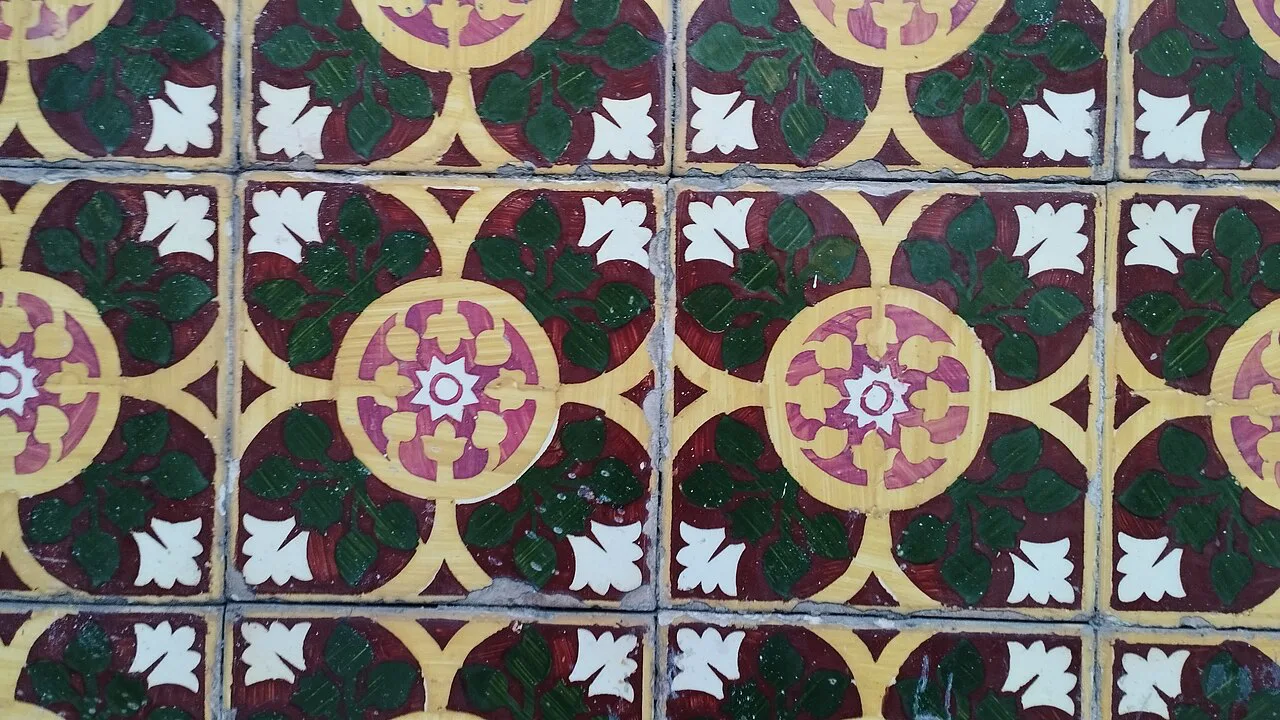
Blue and white dominates among surviving historic panels, and because many of these tiles were blue and white it is often assumed that azulejo must derive from azul, the Portuguese word for blue. It does not. Once you start looking, you will find yellows, greens, ochres and manganese purples in older work, especially in repeating border patterns and in polychrome panels.
An azulejo is a glazed ceramic tile, usually square, fired at high temperature so the glaze fuses to the clay body.
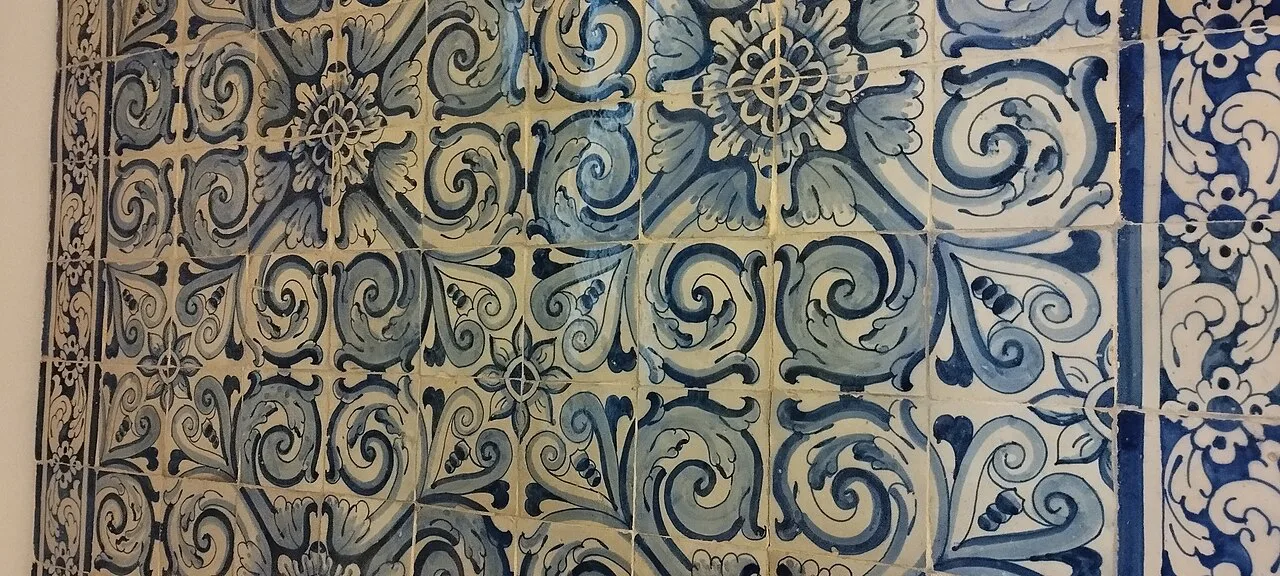
Most of what you see on Portuguese streets is a repeat pattern, a small motif stamped across hundreds of tiles to clad a wall from ground to eaves.
Inside a tiled church, look low and across before you look up.
The sheer quantity of blue-and-white tiling on Portuguese churches, palaces and townhouses is what fixes the palette in most visitors' minds, so a walk through an older town will read as overwhelmingly blue even where older polychrome schemes survive. Look closely at borders and at panels in side chapels, which often preserve a wider range of colour than the street-facing walls.
How azulejos are made: hand-painted and glazed ceramic, fired at high temperature
Traditional production starts with a flat clay tile, which is coated in a white tin glaze before the design is applied. The painter works directly onto the unfired glaze, so any wobble in the brushwork stays in the finished piece, and the tile then goes into a kiln at high temperature where glaze and pigment fuse into one surface.
That firing is what makes tiles such durable cladding, which is why exterior murals survive for generations outdoors. Modern Portuguese-made hand-painted ranges for exterior walls are still sold, including a range at 15cm square, forty-four to the square metre.
The hand-painting step is what separates a reproduction panel from a printed tile. Expect slight variation in line weight and colour across a hand-painted batch, and treat perfect uniformity as a sign of industrial printing rather than a fault.
Repeat patterns versus figurative panels: what you are looking at on a façade
Most of what you see on Portuguese streets is a repeat pattern, a small motif stamped across hundreds of tiles to clad a wall from ground to eaves. Read these as texture: step back and judge how the design changes colour as the light moves, and look at how the pattern is corralled at corners, windows and rooflines by a border or a plain band.
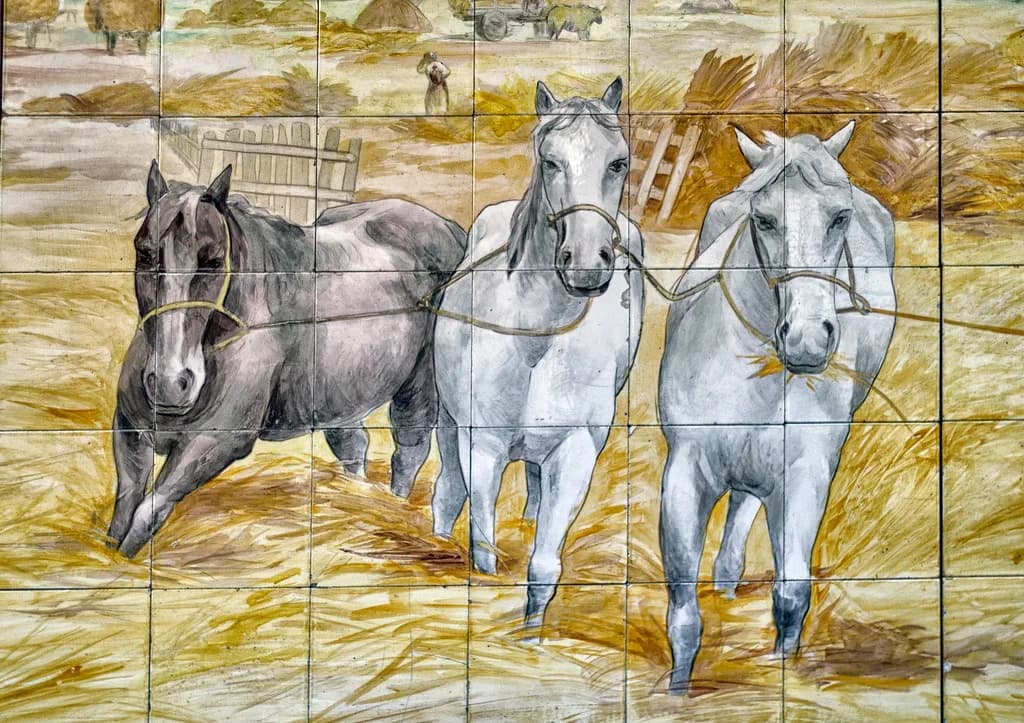
Figurative panels work the other way round. These are composed as pictures, often in blue and white, spread across many tiles to show a scene, a saint, a battle or an allegory, and they need to be read in sequence rather than as decoration. Start at the left of the composition, find the main figure, then look for the smaller narrative scenes tucked into the margins.
Tiles as building material: heat, fire and the rebuilding of Lisbon after 1755
Tiles were never purely decorative. Applied to a façade they helped hold warmth inside a building, and because they are baked at high temperature they also helped delay the spread of flames in a fire. After the 1755 earthquake destroyed most of downtown Lisbon, the central area had to be rebuilt quickly, and in the 19th century tile proved a cheaper way than stone or other sturdy materials to clad the new buildings.
That practical history explains why tiled walls are so widespread rather than confined to grand buildings. On a walk, look for a tiled ground-floor face beside a plain rendered upper storey on the same building, and you are probably seeing a later, cheaper addition rather than an original scheme.
How the use of tiles moved from interiors to street-facing façades
Until the 19th century, tiles were mostly an interior material, lining kitchens, stairwells and church naves. From around the 1840s their use spread to the outside of buildings, decorating the street-facing walls of churches and palaces and, increasingly, the houses of a prosperous middle class who wanted to stand apart from their neighbours.
Families who had made money abroad, particularly in Brazil, returned and wrapped their new townhouses in elaborate tiled panels as a public display of status. The fashion faded in the early 20th century as tiles lost their association with elite taste, then revived in the 1950s, when Lisbon's metro opened with stations decorated in colourful tile patterns, many designed by Maria Keil.
Reading a tiled church or palace interior: where to look first
Inside a tiled church, look low and across before you look up. The best panels generally sit on the nave walls at eye level or slightly above, where they were meant to be seen, and the lower band is usually a repeat pattern protecting the wall from damp and scuffs.
Take a moment to work out where the panel begins and ends. In a well-composed interior, tiled scenes sit inside painted or carved frames, and the border tiles, often a different design, mark the edge of the picture; that border is your fastest clue to whether you are looking at a planned scheme or later patching.
How to tell an old panel from a modern reproduction
Start with the glaze. On genuinely old exterior work the surface has usually lost some shine, shows hairline crazing and carries a slightly uneven colour across neighbouring tiles, while a modern printed reproduction stays flat and consistent. Then check the edges: hand-made old tiles vary a little in size, so the grout lines waver.
Next, look at how the panel meets its surroundings. Historic schemes were designed for the wall they sit on, so the pattern turns a corner, resolves at a window and ends at a roofline with intent; a reproduction tends to stop abruptly where the sheet ends. Above all, read a façade with persistent cracking and patchy replacement as a record of age, and be wary of any tiled surface that looks too even to have survived a century of Atlantic weather.
Where to see azulejos on a short break outside Lisbon and Porto
Azulejos are not confined to the big cities, so any short Portuguese break puts tiled walls in front of you. Train station concourses, parish churches, market halls, hospital entrances and ordinary residential streets all carry tile work, and the advantage outside Lisbon and Porto is that you often have a church nave or a station wall to yourself.
The practical rule is to detour into any station booking hall and any church you pass with its door open. Both were built to impress, both used tile because it was durable and grand, and both can give you a large panel to read.
Buying Portuguese tiles: shops, factories and what to weigh up
If you want to understand how tiles are made before you buy, Fábrica de Sant'Anna has operated in Lisbon's Lapa neighbourhood since 1741 and still works to artisanal methods; it runs guided tours of the production process and has showrooms in the city. Its business expanded sharply when the 1755 earthquake triggered demand for tiles across the rebuilding. Check tour days and times directly with the factory before you build a morning around it.
For replacements or a specific historic design, Cortiço e Neto in Lisbon holds a very large stock of tiles covering both common modern patterns and rarer older ones, which makes it the better bet when you need to match something already on a wall. XVIII – Azulejo & Faiança, in Alfama, specialises in tiles and pottery inspired by 18th-century designs rather than antiques.
If you want the wider picture on buying glazed tile in Portugal rather than just the Lisbon shops, Where to Buy Azulejos in Portugal covers the options. For pottery rather than tile, see the pottery guide before committing. For more on what is worth carrying home, see Portuguese souvenirs worth buying.
Hand-painted versus mass-produced tiles: what the difference means for price and use
A hand-painted tile carries the maker's brushwork, so no two are identical and the surface may show deliberate variation. A mass-produced or digitally printed tile reproduces a design exactly and cheaply, which is fine for a splashback but obvious the moment it sits next to historic work.
Prices vary by workshop, size and finish, and no single figure covers the market, so ask the shop or factory for its current price list rather than relying on a figure you read online. Decide first whether you want a piece to decorate a wall or an authentic antique, and shop accordingly.
Buying tiles to take home: size, weight and outdoor use
Ceramic is heavy, and a square metre of 15cm tiles runs to forty-four pieces, so weigh up how much you can realistically carry before you fall for a full panel. Ask the shop how it packs for air travel, and plan to carry tiles in hand luggage rather than trusting them to a hold bag.
For an outdoor wall, choose tiles sold specifically for exterior work rather than interior tiles that happen to be glazed. For an indoor splashback or fireplace surround, weight and weather exposure matter far less, which opens up the cheaper interior ranges.
Is it worth buying tiles or just photographing them?
Photograph the panels you love on the street, and only buy if you have a specific wall in mind and a plan for getting the tiles home intact. A handful of hand-painted tiles makes a lighter, more useful souvenir than a full panel you cannot fit in a case.
Whichever you choose, look at the tile work on your next short break with the questions above in mind and the façades will start to sort themselves into old schemes, later patching and modern reproduction.
Explore more Portugal guides
Sources
Notes for your next Portuguese break
Optional updates to our town guides.
You might also like



Continue reading
More guides you'll find useful




