São Bento Station, Porto: The Azulejo Panels and What They Show
What the azulejo panels at São Bento station in Porto show, who made them, how to read the scenes and how long the visit takes on a short break in Porto.
On this page
São Bento station is worth a stop, and it takes about fifteen to twenty minutes rather than an afternoon. The building is a working terminus in central Porto, and its atrium carries around twenty thousand pictorial tiles by Jorge Colaço, so this guide reads the panels as a sequence instead of a single photo. It then places the station on a walking route through the historic centre and sets out what the building's own story adds.
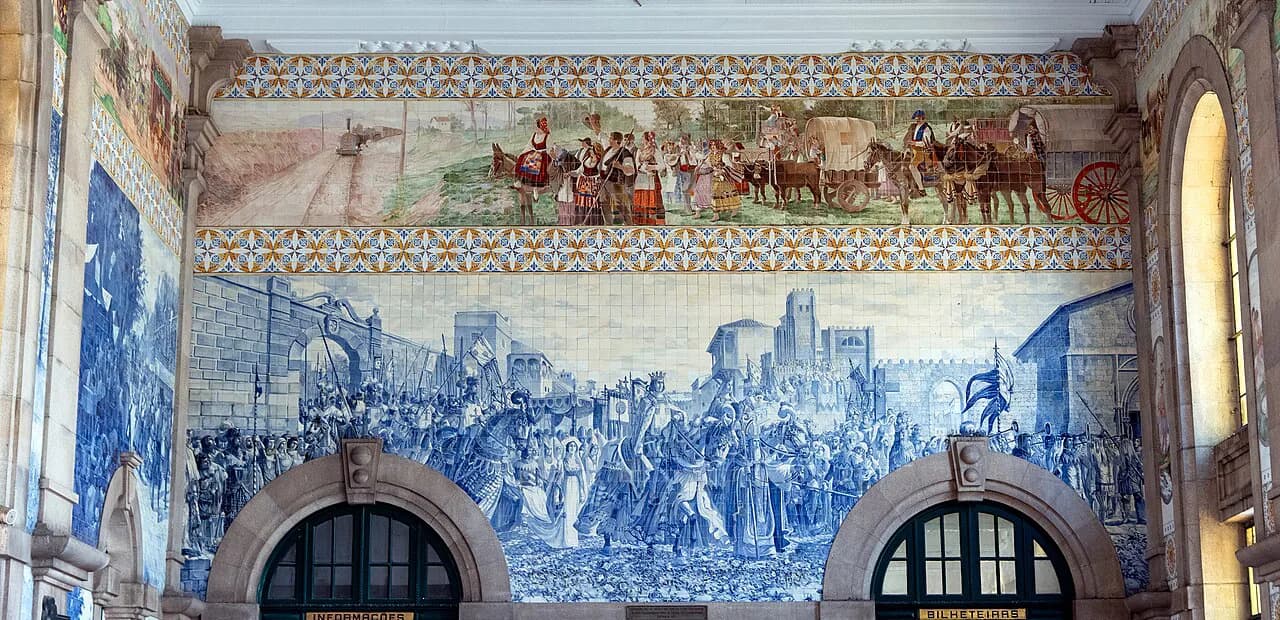
The order is the point. The history scenes sit low, at eye level as you cross the hall, while a colourful frieze runs right around the upper atrium with transport and everyday subjects. Read the two registers separately and the commission makes sense as a public statement about a young republic's past and progress.
What São Bento station is and why travellers stop for it
São Bento is a central train terminus in Porto's historic centre, close to Praça Almeida Garrett, and is famous for sweeping tile murals across the main hall. Porto's mainline services are widely associated with Campanhã, with a short connecting hop to São Bento for the centre; confirm which station your ticket names before you rely on arriving here.
Travellers stop because the atrium doubles as one of the largest tile schemes in Portugal, and because it costs nothing to walk in and look. This is the difference from a museum: there is no ticket desk, no audio guide and no fixed route through the space, so you make your own reading of it. What it lacks is interpretation on site, which is why the sequence below is useful before you go.
Where the station sits in Porto and how to reach it on foot
The station stands on Praça Almeida Garrett in the parish of Cedofeita, Santo Ildefonso, Sé, Miragaia, São Nicolau e Vitória, which is the historic heart of the city rather than a suburban interchange. That address matters for planning: you can step off a train and be in the old streets within a couple of minutes, without a metro ride or a taxi.
On foot, the station sits between the grid of streets climbing towards the Clérigos area and the lower streets dropping to the river. Treat it as a hinge in a walking day: see the atrium, then take one direction uphill for churches and viewpoints or downhill for the riverside. Central Porto is hilly, with calçada pavements that turn slippery in rain, so shoes matter more than distance on these short hops.
How many azulejos cover the atrium and who designed them
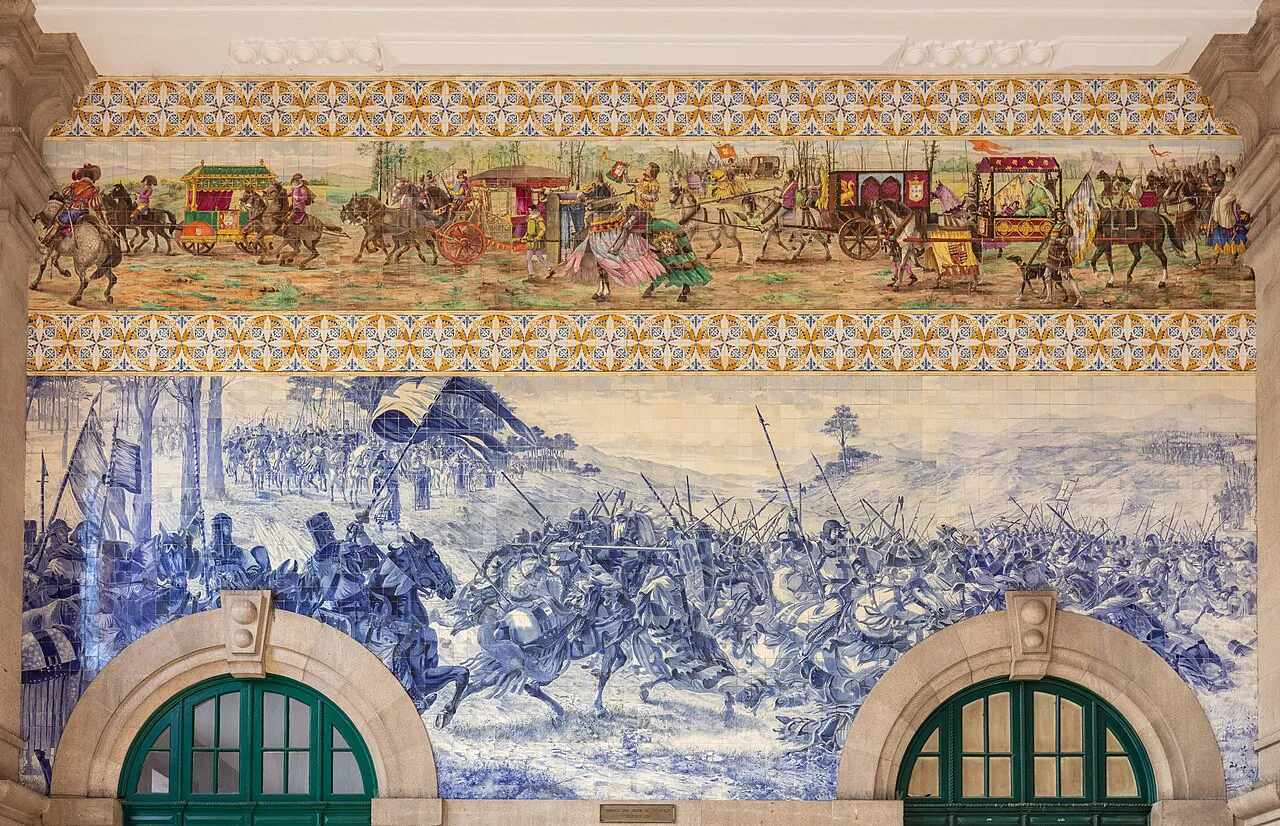
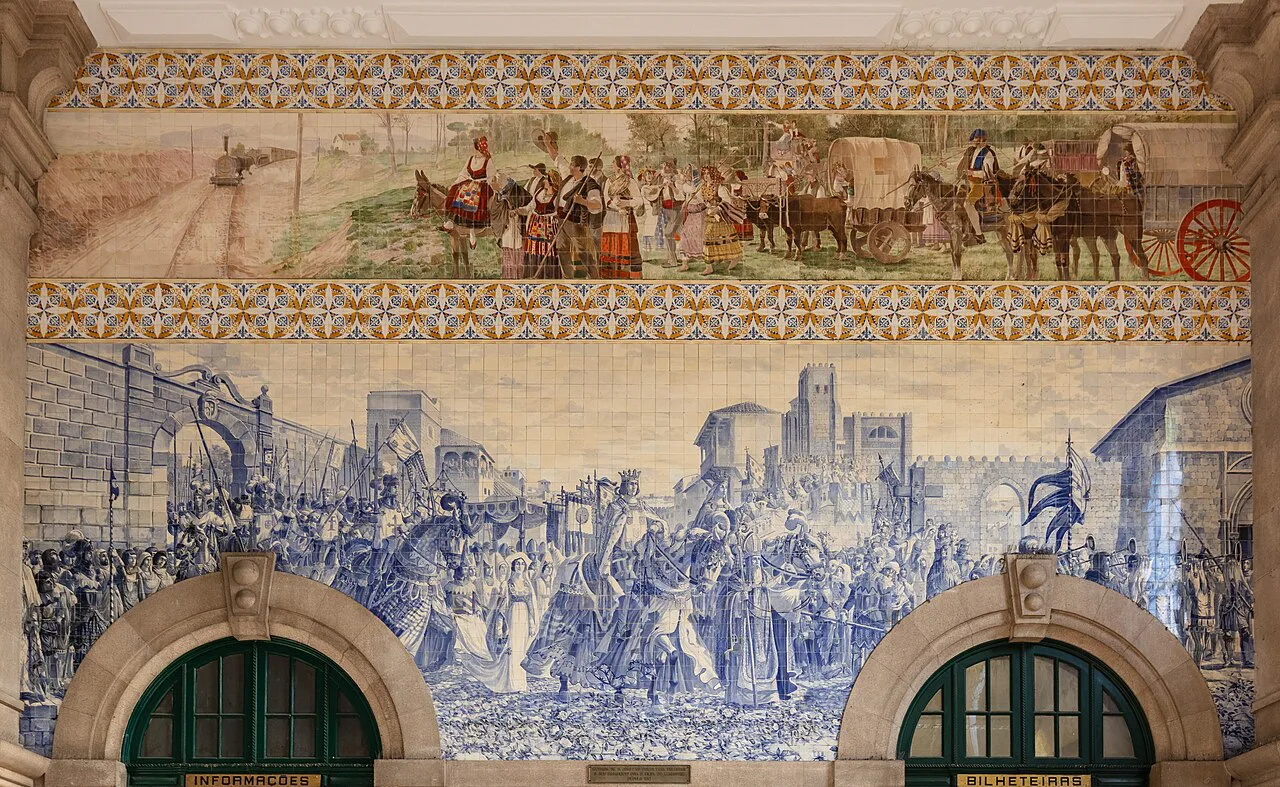
The spacious atrium is lined with around twenty thousand pictorial tiles by Jorge Colaço, described as being of a luminous, profound Delft blue. The composition is a single wraparound scheme rather than isolated panels, which is why the blue-and-white register reads as one continuous pictorial frieze.
If you want the techniques behind this kind of work, the broader story of Portuguese tiles covers how azulejos were made, painted and applied to façades and interiors across the country. It helps you notice that São Bento's tiles are painted in a historicising style, closer to nineteenth-century revival work than to the mass-produced patterned façades of the same era.
What the history panels show, scene by scene
The pictorial tiles carry scenes from Portuguese history alongside ethnographic representations, so the band works as a narrative of battles, royal entries and rural life arranged for a traveller crossing the hall. Read them anticlockwise as a rough chronology rather than as separate pictures; the low panels are the ones you can actually study at close range.
Look for the battle compositions, which use crowded figures and horses against the blue ground, then the quieter ceremonial scenes with processions and figures in court dress. Painted tile gives a flat, graphic image, so crowds of soldiers read as pattern first and detail second; step back a few paces and the composition resolves. The ethnographic panels change gear entirely, showing regional dress and rural occupations as a record of the nation's people rather than its rulers.
What the ethnographic and transport frieze adds
Above the pictorial panels, a colourful frieze runs right around the atrium and tells the story of the means of transport, mixing vehicles and machines with scenes of everyday life. This upper band is the part most visitors photograph least, because it sits high and reads small from the floor. Move to the centre of the hall and turn slowly rather than trying to capture it in one frame.
The pairing is deliberate: history and ethnography below, transport and daily life above. Set in a railway station, the frieze turns the building into a piece of civic storytelling about movement and modernity, which is exactly what a terminus meant when it opened in the early twentieth century. If tile-making as a craft interests you, the Portuguese pottery tradition of the same period shows how ceramics moved between architecture, decoration and household use.
How long to allow and the best time of day to see the tiles
Fifteen to twenty minutes is enough for a careful pass through the atrium. Allow longer if you plan to read the history panels closely, because the good light and the readable detail do not always coincide. The trade-off is simple: this is a public concourse, so the visit is a browse, not a studious examination.
Treat it as a working terminus and plan around departures. If you want quieter viewing, go early in the day before the station fills with passengers and tour groups are moving through; the atmosphere is better, and photography is easier. At peak times, stand clear of the concourse centre and find a wall position where you can look up without blocking foot traffic.
Single visits are free, so no ticket is needed for the atrium. If a piece of glazed tile is what you want to take home, the city's tile shops and their stock are covered in the guide to where to buy azulejos in Portugal, rather than from the station itself.
The building itself: architect, dates and the convent site
The station was designed by the architect Marques da Silva. King D. Carlos I laid the foundation stone in 1900, on the site of the old Convent of Avé Maria, and the building was inaugurated in 1916, with conservation and restoration work following in 2010.
Placing those dates helps: a Beaux-Arts station of this scale, built on a former convent site and decorated with painted tiles, sits squarely in an era of urban renewal. The blue-and-white panels draw on a much older ceramic language rather than the carved stone of Manueline architecture, which is the stylistic contrast to look for in Porto's churches.
What else to see within a few minutes' walk
The station's neighbour is Livraria Lello, listed as 450 metres from the station, though its own published visiting hours cover part of the week only and should be checked before you set out. That short walk is the most obvious pairing, and it keeps the visit to a compact half-day rather than a trek.
Beyond those two, the station's position gives you an easy loop: uphill towards the cathedral quarter and the Clérigos area, or down through the old streets to the river. Build the loop around what you actually want to see rather than around the station, and keep the tile visit as a twenty-minute hinge in the middle. If you collect small things as you go, Portuguese souvenirs such as tinned fish, soaps and notebooks are sold in the surrounding streets; the traditional pottery centres of Caldas da Rainha and Costa Nova are elsewhere in the country, not in Porto.
Practical points: opening access, closures and station facilities
As a terminus, the atrium is a public concourse that you walk into as a passenger or a passer-by. The published opening hours and dates for the Livraria Lello Foundation belong to that institution, not to the station, so do not apply them to access to the hall.
There are no published prices for seeing the tiles, no guided visits and no set viewing sequence, so plan the stop around your own walking route. Check your train times with the operator on the day you travel rather than from any schedule printed in a guide, and confirm any advertised facilities in the building on arrival.
Is São Bento station worth the stop?
Yes, if you are already in central Porto, and no, if you would need to go out of your way. The atrium earns its reputation on the strength of one continuous painted scheme, and twenty minutes of reading it properly is a better return than an hour of photographing it. Slot it into a walking day between the old streets and the upper town, then move on.
Read the history panels first, then walk the upper frieze, and leave before the concourse gets busy. If tiles become the theme of your trip, follow the wider azulejos in Portugal guide for the museums, factories and façades that take the story further than one station hall.
Frequently Asked Questions
Where is the main train station in Porto?
São Bento is a central terminus in the historic centre, close to Praça Almeida Garrett, and it is the station most travellers reach on foot from the old streets. Porto also has Campanhã, commonly the arrival point for mainline services with a short connection into the centre, so check which station your ticket names before you travel.
Are the São Bento tiles free to see?
Walking into the station atrium to look at the tiles is free, since the hall is part of a working terminus rather than a ticketed museum. There is no published guided visit or interpretation, so read the panels yourself or prepare before you arrive.
Sources
Notes for your next Portuguese break
Optional updates to our town guides.
You might also like
Continue reading
More guides you'll find useful