
Ferragudo: A Short Break Guide to the Algarve Fishing Village
Plan a short break in Ferragudo, the Algarve fishing village across the Arade from Portimão, with its old centre, hilltop church, river fort and beaches.
On this page
Ferragudo needs half a day for its old centre and waterfront, and a full day if you add the lighthouse and the beaches east of the village. The village sits on the Arade where the river meets the sea, directly opposite Portimão, and it holds a small square, a hilltop church, a river-mouth fort and a string of coves within walking distance of each other. This guide lays out that geography, says what to see in what order and explains the car-versus-no-car trade-off. It is one stop in our wider pick of the best towns in the Algarve rather than a base for a week.
The village has stayed modest because Portimão next door carries the hotels, marina and traffic. That contrast is the point: you get whitewashed lanes and fishing boats at the quay, and a bigger town with transport links a short bridge or ferry hop away. Portimão works as the practical pairing, covered separately in our guide to Portimão in One to Three Days, and Ferragudo is what you cross the water for.
What Ferragudo is and where it sits
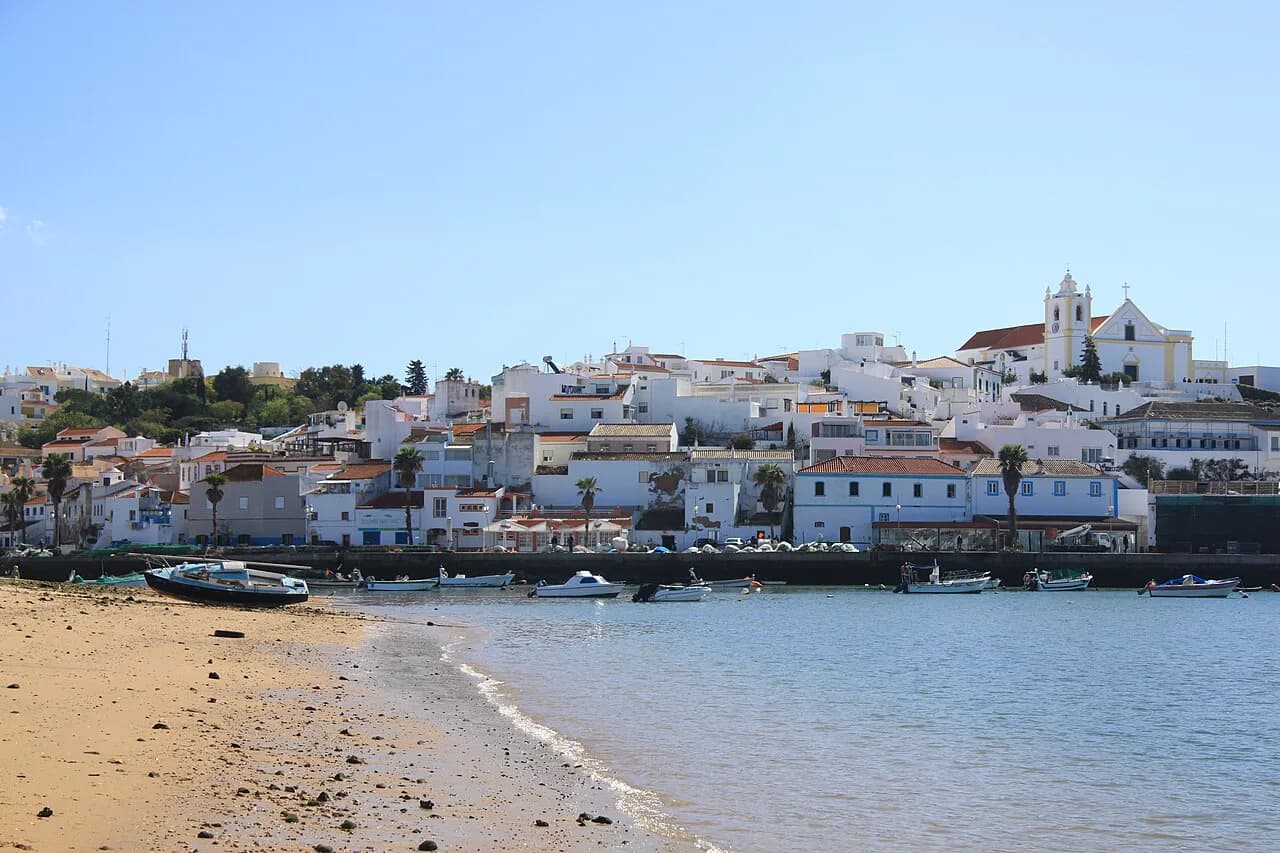
Ferragudo is a fishing village in the Algarve, set at the mouth of the Rio Arade opposite the larger Portimão, and its streets are lined with the typical Portuguese cobbles and whitewashed houses. The centre is small enough to cross on foot, and much of it is car-free, with lanes so narrow that driving through would spoil the atmosphere. Start at the main square, Praça Rainha Dona Leonor, which opens onto the quay where fishing boats are moored.
The name is usually traced to ferro and agudo, iron and sharp, after the iron spikes once placed in the river to block enemy ships, and the village's history runs back through Roman and Moorish traces to a long spell as a working fishing harbour. That past still shapes what you see: the old harbour, the fishermen's houses and a waterfront that unloads the morning catch. The São João de Arade fort at the river mouth is the surviving marker of the village's defensive role.
How much time Ferragudo needs
Treat Ferragudo as a half-day stop if you want the square, the lanes and the waterfront, and a full day if you add the church, the fort viewpoint, the lighthouse and a beach. The sources put the old centre, the water and the surrounding beaches at roughly half a day, with the lighthouse further out and easier to reach by car. A relaxed pace suits the village better than a checklist, because the pleasure is in climbing the stepped alleys and finding viewpoints over the river.
If you have one day, give the morning to the old centre and the church, take lunch near the square, then drive or walk east for the lighthouse and a beach in the afternoon. With two nights, you can spread the fort, the lighthouse and the beaches over separate mornings and leave the hottest hours for the shade of the lanes. Anything longer and you are using Ferragudo as a base, which is better served by Portimão or one of the larger Algarve towns.
The old centre on foot
Begin at Praça Rainha Dona Leonor, the village's main square, which has cafés and restaurants around it and sits close to the quay. From there, head towards the church but resist the most direct route: the fun is in wandering the narrow, interconnected streets, climbing stairs up and down, and stumbling on bougainvillea arches and painted doorways. Most of the centre's streets are car-free, so you can walk without watching for traffic.
Photographers should allow extra time, because the whitewashed houses with blue and yellow trim, potted plants and flower arches turn up around nearly every corner. The streets are steep in places, so wear shoes that cope with cobbles and steps. Shops in the centre sell handmade souvenirs, which is a good way to spend a slow half-hour before lunch.
Igreja de Nossa Senhora da Conceição
The Igreja de Nossa Senhora da Conceição sits on a gentle hill above the village, whitewashed outside with yellow trim and Portuguese tiles on its walls. From its height it looks over the Arade and across to Portimão, so the walk up earns you a view as well as the church itself. The climb is short but stepped, and it slots naturally into a loop back down through the lanes.
The church features among the village's main sights in local guides, alongside the fort and the beaches. Its doors keep whatever hours the parish sets, and the sources here give none, so time your visit as part of a walk past rather than around a fixed opening. If you want to see inside, check the notice on the door when you arrive.
Castelo de São João do Arade
The Castelo de São João do Arade, built in the 17th century, guards the mouth of the Arade and stands as evidence of how strategic this river crossing once was, raised to defend the coast from pirate raids. It is a fort to see from the outside, set on the riverbank where the water widens towards the sea. Pair it with the walk along the front rather than treating it as a separate outing.
Farol da Ponta do Altar
The Farol da Ponta do Altar, the lighthouse east of the village, is the sight that stretches a half-day into a full one. It is far enough from the centre that a car makes it much easier, and local advice is to drive if the lighthouse is on your list. The reward is the coastal setting out towards the cliffs, where the land turns rugged beyond the village.
Praia da Angrinha, Praia Grande and Praia dos Caneiros
Ferragudo has three beaches worth knowing: Praia da Angrinha, closest to the village and the fort; Praia Grande, the long stretch that faces Portimão across the river mouth; and Praia dos Caneiros, further east among the cliffs. All are backed by colourful cliffs and suit a simple day of lying on the sand or strolling the shoreline. For a short break, pick one and let it fill the afternoon rather than trying to tick off all three.
Praia da Angrinha is the practical choice if you are on foot, because it sits within easy reach of the old centre and the fort. Praia Grande and Praia dos Caneiros reward a car, since they lie further from the village and away from the lanes. The Skyscanner destination page for Ferragudo is the place to compare options if you want to build a fuller beach day.
Eating in Ferragudo
Seafood is the reason to eat here: the boats moored along the quay land the catch the village cooks, and the cafés and restaurants around Praça Rainha Dona Leonor serve local dishes built around it. Lunch on the square, with the boats in sight, is the obvious move. Menus change with the catch and the season, so read the board outside before choosing a table.
Portuguese restaurants commonly keep one closing day a week, though which day varies by establishment, so check the door or phone ahead if a particular place matters to you. The same applies to holiday periods, when opening can shift. Book nothing on assumption; a short call or a look at the posted hours settles it. This is the pattern across the Algarve's smaller towns, including the market town of Loulé: What to See in the Algarve's Market Town.
Boats on the Arade
Boat trips leave from the village for the Arade river and along the coast towards Silves and Benagil, and river trips are one of the standard ways to see the water from a different angle. Operators set their own timetables and routes, so confirm departure points and times at the quay on the day rather than planning around a fixed schedule. A sailing trip on the Arade by solar boat is among the options local guides list.
Getting to Ferragudo without a car, and where to park
Ferragudo sits directly across the Arade from Portimão, which is the transport hub for this stretch of coast: buses and trains bring you to Portimão and you cross the water from there. The village itself is small and walkable once you arrive, with the old centre largely car-free. Skyscanner's Ferragudo guide is a reasonable starting point for comparing travel options into the region.
If you drive, park outside the narrowest lanes and walk in, since the centre's streets are too tight for comfortable driving and much of it is pedestrian. The lighthouse and the eastern beaches are the parts that genuinely need a car. Local advice describes parking in Ferragudo as free, but check the signs where you leave the car.
Ferragudo or Portimão as a base
Portimão wins on convenience: it has the hotels, the marina, the transport links and the services, and it sits right across the water. Ferragudo wins on atmosphere, with its quiet lanes, fishing boats and small square, but it has fewer places to stay and less to do in the evening. For a one- to four-day short break, most travellers should sleep in Portimão and spend a day or two of it in Ferragudo.
The same trade-off appears elsewhere in the region, where a bigger town provides the base and a smaller village supplies the day out. Olhão: Markets, Cubist Houses and the Ria Formosa works that way for the eastern Algarve, and Alte, Algarve does it for the inland hills. If you are weighing the whole coast, our picks for the best towns in the Algarve set them side by side.
Half a day or a full one?
Give Ferragudo half a day if the old centre, the square and the waterfront are enough, and a full day if you want the lighthouse and a beach as well. Base yourself in Portimão, cross the water, and let the village set the pace rather than a schedule. Arrive early enough to walk the lanes before the heat builds.
Explore more Portugal guides
Frequently Asked Questions
Is Ferragudo worth visiting?
Yes, for a half-day or a full day. The old centre, the hilltop church, the river-mouth fort and the beaches give you enough for one unhurried visit, and the village's working-harbour character is what makes it stand apart from Portimão. It suits travellers who want a quiet day out rather than a resort.
How much is a taxi from Faro airport to Ferragudo?
Fares are set by the taxi operator and vary by time, route and luggage, so confirm the price with a licensed operator at Faro airport before you set off. A taxi is one option; buses and trains run to Portimão, from where Ferragudo is a short crossing away. Compare the options before you commit.
Sources
Notes for your next Portuguese break
Optional updates to our town guides.
You might also like



Continue reading
More guides you'll find useful





